Go to the U of M home page
Showing posts with label Hybrid Learning. Show all posts

Thursday, April 25, 2013

German Hybrid Development: The Digital Story So Far

This is the last of a series of articles on hybrid courses. The series began with an interview with Dan Soneson, who coordinates the Hybrid Working Group, followed by a Spotlight on Spanish Hybrid Courses and La Vie Branchée: French Hybrid Classes.


Hailley VT
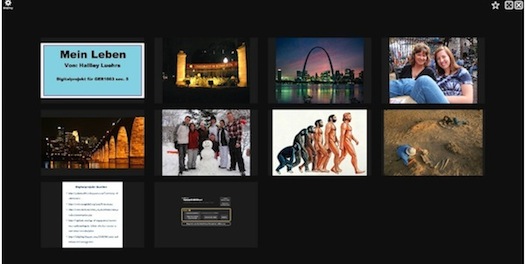
Screenshot from a student's digital story.

German hybrid, first offered in Fall 2012 for German 1003, is the newest of the hybrid courses currently offered at the University of Minnesota. German hybrid is unique in that it integrates new technology such as Avenue, a video recording tool, VoiceThread for digital storytelling, special Moodle tools, and Wimba Voice Board.

In the summer of 2011, Beth Kautz, a German 1003 coordinator, participated in a hybrid course in Munich about teaching hybrid language courses. "This was a transformative experience for me, which led to a year of planning before actually developing the course in the summer of 2012," Kautz said.

A small team of graduates and coordinators received a "Tools for Discovery Grant" and funding from CLA, which allowed them to create new hybrid course materials.

Kautz said German hybrid developers created their own course materials based on reading texts, podcasts, and video clips from the internet. This development allowed the German department to offer two sections of hybrid 1003 in Fall 2012, and one section of hybrid 1003 and two sections of hybrid 1004 in Spring 2013. These hybrid courses met face-to-face three days a week and online two days.

New Technology


Developers experimented with different technology, including a video-recording tool developed at the University of Minnesota, called Avenue. Classrooms also integrated Moodle tools such as discussion forums, databases, glossaries, and polls, as well as the Wimba Voice Board.

Kautz said the highlight of the semester was using a tool called VoiceThread for digital storytelling. Students received instructions on using the technology. She described the project as an autobiographical essay about their youth experiences that have shaped their current educational and career goals. The student used personal photos and voice recordings to present their stories visually.

"Students focused on presentational speaking skills to make their stories engaging and easy to understand. All the digital stories were linked in a Moodle forum, where classmates could view and comment on each other's creative work... Students were able to complete the project on their own and we were all thrilled with the results! They took great pride in their stories and the sense of community was really strengthened by sharing them with each other."

    - Beth Kautz, German 1003 Coordinator

Instructor Feedback and Outcomes


Ginny Steinhagen, German 1004 coordinator, noted that hybrid instructors are learning the benefits of spreading out deadlines for student's feedback in forums, by allowing adequate time for students to respond to each other's posts.

Steinhagen emphasized the importance of instructor feedback for online activities in hybrid courses.

"In 1004, [Meagan Tripp, 1004 German instructor] has created some nice, quick Moodle quizzes that show us whether the students are understanding the reading or the grammar. As teachers, it is important for us to follow up on these quizzes (even if they are self-correcting) and comment on them in class. Integrating the hybrid day activities into face to face discussions continues to be a challenge."

   - Ginny Steinhagen, German 1004 Coordinator

Kautz added that there is great variation in how instructor feedback occurs and how students' assignments are submitted. "There are many possibilities and we are still figuring out what works best in which situation," she said.

At the moment, developers do not have specific data on student's performance comparing German hybrid and traditional face-to-face courses. Kautz noted that there are many variables to consider and considerations in terms of how to define performance. However, Kautz said, "I anticipate that students in hybrid sections will become more fluent writers through increased writing practice in online discussion boards, but that's a research project for the future."


Thursday, March 28, 2013

La Vie Branchée: French Hybrid Classes

This is a continuation of a series of articles on hybrid courses. The series began with an interview with Dan Soneson, who coordinates the Hybrid Working Group, followed by the Spanish Hybrid article.


With the debut of French 1004 in Fall 2011, French was the second language program to offer lower-level hybrid courses. Since then, curriculum developers have experimented with different proportions of weekly face-to-face meetings with online components at the 1003 and 1004 levels. French 1002 was added as a hybrid course this spring.

One of the most exciting developments in hybrid French 1004 is the integration of TandemPlus class-to-class exchanges between U of M French students and English learners from Troyes, France. Students are assigned to communicate via Skype with their language partners on predetermined topics that complement the themes covered in the curriculum.

Trina Whitaker, French 1003/1004 coordinator and instructor, said "This is, for many students, a very positive experience."

Corbin Treacy, a French 1004 hybrid instructor, also described the online webcam activities as a positive experience for students. "My students got a lot out of the Skype exchanges," he said. "One student traveled to France over the summer and stayed with her exchange partner; other students have told me they are still in contact with their 'correspondent.'"


Experimentation with French Hybrid Format


Rick Treece taught a traditional five-day-a-week French 1004 class this fall. On the first day, he asked students how often they would like to meet, while maintaining the same five credit load. The majority responded that they would like to meet four days in-person and one day online. Treece then revised the syllabus to the four-day-a-week format (4+1), with an optional day when work could be done face-to-face if the students chose to.

Treece found that there was relatively high attendance on the optional days, with over half attending. However, most of his students had expressed interest in continuing past French 1004, which was not typical of other classes. Students who plan to continue studying the language beyond 1004 tend to be more intrinsically motivated.

For instructors and students alike, certain French hybrid formats require more work. This Spring semester, Whitaker is teaching a 4+1 hybrid course after teaching 3+2 hybrid. "I am frankly shocked at how much less time I have to spend on my teaching, when the class meets more often," she said. "The 3+2 classes are a lot more work - there is more grading, more planning... just more of everything that takes a lot of time."

Hybrid French 1002 course, introduced this fall, utilizes the software Connect, a new hybrid interface for the textbook Deux Mondes.


 Reactions to Hybrid Content


The French hybrid format allows instructors to experiment with content to engage students. Treece was surprised by students' reactions. "Results didn't always match my expectations: a session on use of online translators, which I expected to be wildly popular, only attracted 4 students."

During the first semester of French hybrid, students could do work based on the individual's level of skill in French, but it did not always relate directly to the course content. This method included using separately purchased software based on readings, video, audio and grammar exercises, Whitaker said.

"There was a disconnect between what the students were being asked to do outside of class and what we were doing in class," Treacy said. "Initially, they liked the concept of independent learning, increased flexibility, and targeted online linguistic support. Before long, however, students began to look upon the online exercises as burdensome and arbitrary."

"Things that seem to work better," Whitaker said, "are having students do readings or watch videos that we select within the department and can make sure are entirely relevant to our course content."


Best Personalities for Hybrid


Whitaker found that, for students motivated and strong in French, hybrid is successful and adds extra motivation. However, she said, "students who are less strong in French, or who are not motivated, can find that the course feels like a lot more work to them." Whitaker explained that for a student who is used to the traditional format, which allowed more reliance on peers and instructors to answer questions, he or she is less successful.
"When students are doing the hybrid work, they are on their own, and they must do their best to figure things out without outside help, without relying on others. So it makes sense that it's taking more time [for these students], even if in reality the same amount of time is going by on the clock - it is more intensive time." - Trina Whitaker
Treacy agreed. "It requires a student who can learn independently and engage meaningfully during the hybrid section's more limited class time. Students who require constant, cyclical instruction, and who need more accountability, seemed to struggle in the hybrid section I taught."

Though the French hybrid format requires a motivated student, it also requires concise instruction. Treacy said, "The adjustment required me to be more organized and thoughtful with class time. Particularly difficult was the balancing act between responding to specific student needs (reviewing a tricky concept, for example) and moving forward with new material."

Treece also mentioned that hybrid courses require a special type of student and instructor. "One of the recurring topics in our Hybrid Teaching Work Group has been consideration of what instructional talents, skills and preferences hybrid and online teaching demand or favor vs. face-to-face teaching."

Hybrid caters to a new generation of online learners. Treece noted, "As we begin to face a new generation of learners who have been learning online their whole lives (and who therefore are comfortable with that sort of instructional delivery and competent in that setting), we hope that we will have bred a new generation of teachers trained in that style of teaching and equally familiar with and comfortable with online learning."


Future Goals


Treacy expressed hope in French hybrid as it improves content in the future, despite student's occasional hang-ups related to content:

"I recall that on a mid-course evaluation, students expressed a simultaneous frustration with the specific forms of the online exercises and an appreciation for the hybrid concept. Despite their struggles to integrate in-class learning and
out-of-class online study, the students overwhelmingly reported they would take a hybrid course in the future."
-Corbin Treacy

Treece described a student's experience with the independence and accountability of the French hybrid format.

"I had a point of clarity when I asked a class about their experience with a (new) video assignment we were piloting. A student remarked that she had gotten a lot more out of it by being forced to do the work on her own. She said that if I had shown the video in class, she would probably have zoned out and waited for other members of her small group to take up the slack, but at home faced with her computer and the worksheet, there was no one else to do the task, so she worked through it herself." - Rick Treece

In addition to continuing the current French 1002 hybrid 4+1 format, Treece said the hybrid French 1003 4+1 format will most likely expand to all day sections in Fall 2013 and will primarily include online video.


Wednesday, February 20, 2013

Spotlight on Spanish Hybrid Courses

This is a continuation of a series of articles on hybrid courses. The series began with an interview with Dan Soneson, who coordinates the Hybrid Working Group.

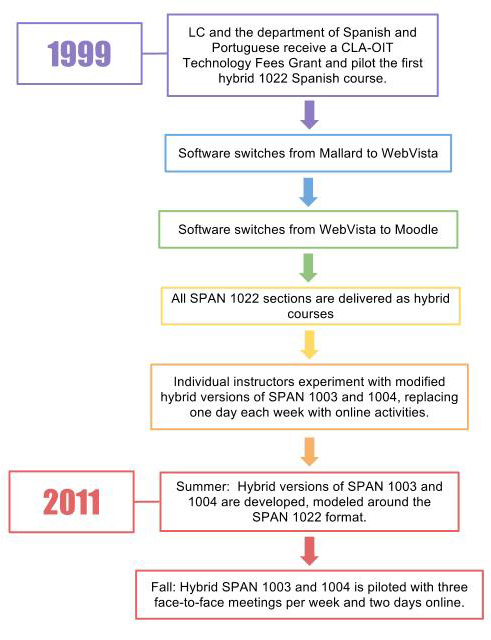
Spanish hybrid courses first launched in academic year 1999-2000, when the Spanish and Portuguese Studies department and the Language Center received a CLA-OIT Technology Fees Grant to create a hybrid version of 1022. At that time, the format was known as "technology enhanced," and was one option for students taking the intensive first-year Spanish course.

Today all sections of SPAN 1022 are technology enhanced. In this 5-credit class students meet face-to-face three days each week and do online and computer mediated activities instead of meeting physically two days each week.

Spanish Timeline
Frances Matos-Schultz, the 1022 Level Coordinator, has managed and adapted the course since its debut. The course has changed considerably over time, as Frances and her fellow instructors learned from experience, and as technology tools have changed.

Spanish is unique among languages at the University of Minnesota in that it offers hybrid courses for introductory students at the 1022 level. Until recently, the hybrid format was restricted to SPAN 1022. While individual instructors in Spanish have experimented with modified hybrid formats in SPAN 1003 and 1004, replacing one day each week with online activities, a concerted effort to create hybrid versions of 1003 and 1004 along the lines SPAN 1022 was undertaken in the summer of 2011. Spanish piloted 1003 and 1004 as hybrid with three physical meetings and two days of online activities each week in Fall 2011.


Adjusting to Hybrid Spanish Courses


The introduction of new Spanish 1003 and 1004 levels of hybrid has been generally painless for learners. Students who had taken SPAN 1022 were already familiar with the format. However, for students who tested into 1003 or 1004 hybrid courses or transfer students, it may have required some adjustment.

Only half of the 1003 and 1004 hybrid instructors had previously taught 1022 courses, Matos-Schultz said, so the move to hybrid for these instructors was more involved and may have been challenging:

"The move from a fully F2F environment to a hybrid (3+2) format was more involved and perhaps a bit more challenging for the instructors that were completely new to hybrid teaching, even though they were experienced and very successful 1003 and 1004 instructors. It required a repositioning of the instructor/learner roles, redesigning lesson plans, rethinking feedback techniques and strategies online and extending the teaching presence online. It was certainly hard work." - Frances Matos-Schultz

Sara Mack, the new Spanish 1004 coordinator, described a smooth implementation of the hybrid format as a goal to serve students. "One of the challenges going forward is to find the best way to provide support so that everyone, regardless of their comfort level with the Hybrid model or with technology in general, can achieve his or her language learning goals and be successful in the Hybrid 1004 class."

One of the possible adjustments students should make when taking the hybrid class is to make sure they treat the online portion of the course as seriously as the face-to-face meeting so that they are fully prepared and can perform well in class.

For the most part, online aspects seem to have helped students. "Students come better prepared to class. Research shows that students who engage with materials online come better prepared to the classroom, thus making better use of the face-to-face time," said Pablo Viedma, Spanish and Portuguese liaison.


What Makes Spanish Hybrid Unique?


Some unique advantages of the Spanish hybrid courses in lieu of traditional face-to-face format include online activities such as group writing exchanges, Moodle homework, Wimba Voice Board, and the Tertulias designed by France Matos Schultz and Megan Corbin. These activities allow students to interact more fully with the course content.

"They engage with this format, see relevant videos about it, converse in forum groups, create voice recordings and write short compositions about topics related to each chapter," said Angela Carlson-Lombardi, Spanish 1003 coordinator.

In hybrid versions of Spanish courses, writing exchanges and feedback occur online, where students can practice grammar, conversation, reading, and writing.

The hybrid format also allows Spanish students flexibility and can accommodate different types of learners. "Students engage with the materials when they are alert, which might be at different times than class times," Viedma noted. "Also, hybrid classes are known to engage diverse learners (introverted learners, for instance). We teach the students the same way that they interact with each other and with the media: through the computer, smartphone or tablet."


Advice for Students, Instructors and Developers


Students who are self-motivated learners and have sufficient time management skills are most likely to perform well in a hybrid course.

Matos-Schultz emphasized the importance of community, patience, and humor when adjusting to hybrid.

"[It's important] to be patient and adventurous with the technology. A good sense of humor is essential. Keep in mind that "going hybrid" is a process that takes time. Trial and error are part of it. Engage your community in the process, particularly your learners. Remember that instructors need support too. Make sure to include a space for learners to create community. An instructor's community of practitioners (and supporters!) is crucial as well." - Frances Matos-Schultz

Goals for Spanish Hybrid Going Forward


In the future, instructors are trying to ensure equality among the different formats of hybrid courses and access to materials. "The online modules also ensure students come prepared for the class, which is what we would like to ensure via online assignment for all of our classes," Carlson-Lombardi said.

At the 1022 level, three online learning modules are currently being updated. "In my sections I have been using additional modules connected to other disciplines," Matos-Schultz said. "I am currently working on them with my students (they provide valuable feedback and are amazing sources of creativity)."

Mack highlighted some core goals that are maintained for all language courses: "As we move forward, I think our goals remain the same as they always have been: to give our students the best language learning experience possible regardless of the format of the class, and to help students understand language and culture as a core part of a liberal arts education."


Tuesday, January 22, 2013

Registration Opens: Teaching a Hybrid Language Course

As language courses here at the University of Minnesota and across the country shift towards a blend of face-to-face and online instruction, most teachers find themselves in unfamiliar territory. They've worked for years developing strategies and techniques for the traditional classroom, but have little experience as either a student or an instructor in the online environment. The CLA Language Center is pleased to offer this semester a 6-week seminar on teaching a hybrid language course.

The seminar will be offered in a hybrid format, with both online components and 3 face-to-face sessions from Feb. 1st - March 14th. The face-to-face sessions will be on Fridays:
February 8th, February 22nd, and March 8th from 11:15 - 12:05 in Jones 35.

Topics to be addressed include:

  • Getting into the course (course preparation, introductions, syllabus);
  • Building Community (starting and maintaining discussions, fostering student peer support);
  • Blending the Course (integration of online activities into face-to-face content and activities);
  • Student Time Management and Coaching;
  • Assessment and Feedback


Please register by Wednesday, January 30th. You will receive information via email about accessing the Moodle site before the seminar begins on Feb. 1st.

Tuesday, December 18, 2012

Free Six-Week Course for Spring Semester: Teaching a Hybrid Language Course

As language courses here at the university and across the country shift towards a blend of face-to-face and online instruction, many teachers find themselves in unfamiliar territory. They've worked for years developing strategies and techniques for the traditional classroom, but have little experience as either a student or an instructor in the online environment.

The CLA Language Center is pleased to announce a 6-week seminar on teaching a hybrid language course during Spring Semester 2013. The seminar will be offered in a hybrid format, with both online components and three face-to-face sessions from February 1 to March 14, 2013.

The face-to-face sessions held on Fridays, 11:15-12:05pm in Jones 35 on the following dates:
  • February 8
  • February 22
  • March 8

Topics to be addressed include:
  • Getting into the course (course preparation, introductions, syllabus)
  • Building Community (starting and maintaining discussions, fostering student peer support)
  • Blending the Course (integration of online activities into face-to-face content and activities)
  • Student Time Management and Coaching
  • Assessment and Feedback

Look for more information and registration forms in January!

Thursday, November 29, 2012

Hybrid Language Courses Expand

hybrid word_cloud

Hybrid language courses, made up of both online and classroom-based instruction, are growing at the University of Minnesota. French and Spanish are piloting refined second-year hybrid courses this semester, while German is piloting its first ever hybrid class this fall in 1003.

Spanish was the first to offer hybrid courses, starting with 1022 over a decade ago. Concentrated efforts to expand hybrid course development began in 2011, when Spanish created hybrid options for 1003 and 1004 and French piloted a hybrid version of 1004.

A Hybrid Working Group was formed during the Spring 2012 semester. It includes representatives from French, German, Italian, Spanish, the Language Center, CARLA and CLA-OIT. The goals of this group are to share resources, compare experiences and learn from one another without producing identical classes for various language programs.

The group worked diligently over the summer and continues to meet this semester. Meetings typically feature at least one technical training and exploration opportunity.

The new hybrid courses address the five national standards for foreign language learning, known as the "Five C's": Communication, Cultures, Comparisons, Connections, and Communities.

I sat down with Dan Soneson, coordinator of the Hybrid Working Group and spokesperson for ComSLE, to learn more about hybrid courses and the process of the work group's collaboration.


Saoirse: How are hybrid courses adjusted/customized to suit different languages? Is there a specific model for the ideal hybrid course?

Dan: It would be great if there were one model out there that we could all adopt, but the concept of a hybrid course has developed over time and only recently have we begun to think about actually replacing class time with time online. We started the process looking at how Spanish 1022 works, and went from there.

We quickly discovered that the amount and quality of prepared online resources available to Spanish is not as readily available to the other language programs, so French, German and Italian had to find and develop more of their own materials. While Spanish had begun with the intensive elementary course, both the French and German programs decided to start at the second year. The reasoning was that by the second year students have experience with the language and might be able to work more independently in a partially online context.

Saoirse: Will hybrid courses expand to more languages and levels in the future? Are there any more languages that may be experimenting with hybrid?

Dan: That will depend on the success of these newly developed courses. The original plan was to have blended learning or hybrid courses in place for at least semesters two through four of Spanish, German, French, and possibly Italian. If we can solidify the models we develop for these languages, perhaps they can serve as templates for related language programs.

Saoirse: Do you think a hybrid model would work with upper division language courses?

Dan: I definitely think a hybrid model can work throughout the curriculum. A great deal depends on what kinds of activities can be developed to take advantage of the wealth of material and communication possibilities that technology provides.

Saoirse: What are student's reactions to these new courses? Instructor's reactions?

Dan: As you can imagine, reactions have been mixed. One thing we've learned is that students discover quickly that this course involves more work than a strict face-to-face class, even though the expected time commitment is equivalent. While it may be possible to participate less in a face-to-face class, online you need to do all the work and demonstrate your participation. This work, however, can yield greater results, since everyone is participating equally.

Instructors also note the increased workload, primarily due to reading and responding to every student's contributions to forum topics and threaded discussions. However, regular classroom participation can increase as well. One instructor stated recently that once the class gets into the rhythm of online work leading to live classroom activities, the quality of the classroom work improves, with more engaged students and more stimulating discussions.

Saoirse: What are the expectations of a hybrid course? What are the characteristics of a student who will be successful in a hybrid course?

Dan: Basically, a hybrid course represents a transformation from a conventional course that meets exclusively in a physical space (a classroom) to one in which a regular number of classroom hours take place online or through use of technology. In our case, the conventional 5-credit course meets regularly at the same hour, five days each week. The hybrid version reduces the physical in-class hours to three each week, while the other two hours take place virtually, with students engaged with similar activities or with the kind of activities that are desirable, but difficult to accomplish in a large class setting.

The expectation is that these online "classes" carry the same weight as a regular in-class meeting, and that students spend at least 50 minutes focussing on the assigned activities, at a time that is convenient for them. In addition to these online activities, students also complete regular homework assignments for each class period, whether it is virtual or face-to-face.

Successful students are well organized self-starters who can work independently and are willing to work with peers outside of the classroom. Much of the "group" work that takes place in the virtual classroom requires teamwork and an ability to contribute to a discussion in a timely manner.

Saoirse: What are some things the Hybrid Work Group achieved over the summer? What kind of technology were instructors trained on?

Dan: The Work Group met weekly over the summer to share ideas and experiences. The idea was to provide both structure and a support system for all instructors working on the process. We had people from CLA-OIT participate and share technologies in an effort to help the instructors develop activities and format the courses. We experienced the capabilities of Moodle, Kaltura, UMConnect, Google Hangouts, TurnItIn, and Avenue.

One of the major opportunities that I see for hybrid courses is the ability to pair our students with speakers of the language they are learning. Our TandemPlus program is developing connections with institutions abroad, and ideally we can connect our learners with learners of English to engage in mutually beneficial regular exchanges in which each participant has an opportunity to discuss cultural issues with a partner in the target language.

Once we have these networks firmly established, our students could spend 50 minutes online with a language partner instead of in class. The possibility of using the language in meaningful communication in 50 minutes is much greater in this situation than in a large class. There is still much work to be done to bring these internet exchanges about in a regular manner, but it would be an excellent activity taking full advantage of what internet technology has to offer. Pilot programs are already underway in French, Spanish, German and Italian.

Saoirse: Is there anything else you would like to add about hybrid language courses in general?

Dan: This hybrid development process provides a great opportunity to rethink our language programs, to take advantage of the wealth of authentic materials available on the internet and the wonderful capabilities of Computer Mediated Communication, such as threaded discussions, chat, voice chat, and teleconferencing. You mentioned the National Standards above. We have an excellent opportunity now to address all five C's through technology, exploring Cultures, Connecting to disciplinary content, drawing Comparisons through in-depth experience of cultural practices and perspectives, and providing access to a vast array of Communities that function in the target language on the Web.

This is the first in a series of articles planned on hybrid course development. Look for future blog entries concentrating on hybrid courses for Spanish, French and German.

Wednesday, April 25, 2012

TandemPlus Class-to-Class Exchanges in the Minnesota Daily

One of the missions of the Language Center's TandemPlus program is to support instructors in the establishment and management of class-to-class exchanges involving Skype. Courtney Johnson, a student in Trina Whitaker's hybrid French 1004 class, wrote a very insightful op-ed piece in the Minnesota Daily last week about her Skype exchanges with her partner in Troyes, France. Courtney described this as "a task that was hard for me to get outside of my comfort zone for, but it has been well worth it." She also said that "this interactive opportunity has opened the door to an entirely new way of learning about culture." We are thrilled to hear great stories like these.

Instructors: if you would like to arrange a class-to-class exchange with a school overseas, contact TandemPlus at tandem@umn.edu.

Friday, November 4, 2011

Sustainability and Language Acquisition: Different Approaches to Integrating Academic Content for Different Languages

When the French, German and Spanish language programs had the opportunity to collaborate on the creation of sustainability-themed content for their courses, they jumped right in. However, curriculum developers from the three programs had a different visions for how the content would ultimately be integrated into their university languages courses.

This spring semester, University of Minnesota language students will have several new opportunities to learn about sustainability at the same time as they continue second language acquisition.

Part of the curriculum development was funded by Title VI to create Foreign Languages Across the Curriculum Content (FLAC) resources for K-12 and university courses. The team working to get these initiatives off the ground is:

Elaine Tarone (CARLA)
Patricia Mougel (French)
Charlotte Melin and Beth Kautz (German)
Susan Villar and Frances Matos-Schultz (Spanish).

Here is an overview of the two approaches the programs took for integrating academic content with second language acquisition, focusing on examples of classes offered Spring 2012:

French and German: Upper-level course enhancement and redesign
FREN 3022 The Language and Culture of Business in France
GER 3501 Contemporary Germany: Environmental Debates--Food, Energy, Politics

Patricia is currently teaching her French advanced oral communication class as a new content-based language course on the theme of water. For Spring 2012, Patricia is revamping her ongoing business course, integrating new content on sustainability while keeping the focus on business overall. In the course students will learn about and discuss sustainable business practices in France through case studies of businesses that have moved towards sustainability in terms of resources selection, product development, marketing and human resources management.

During Spring 2011, Charlotte taught a German course with an environmental literature theme. For Spring 2012, she has completely redeveloped an existing course on contemporary Germany. Students will be able to use this course towards the completion of the Sustainability Minor by petition. Here is the course description:

Public concern about environmental issues is driving social, political, and cultural change in German-speaking countries today--a trend visible in the successes of the Green party in recent elections and plans to decommission nuclear power plants over the next decade. This course (taught in German) looks at the ways environmental imagination is expressed through language and contemporary culture. We will examine the evolution of the environmental movement and European conceptions of sustainability through the lens of nonfiction writings, literature, on-line resources, and film. Historically, concepts of ecology arose out of early 20th century discoveries about interconnectedness, epitomized by the term Umwelt (surrounding world), which was coined by Jakob von Uexküll. In keeping with this systems perspective, we will study examples like food production, energy consumption, and urban design. To take into account the divergent opinions that surround these topics, assignments will include debates, expository writing, and creative projects that probe differing positions.

Spanish: Integration throughout the lower-level curriculum
SPAN 1022, 1003, 1004 Second-Semester and Intermediate Spanish

Spanish has begun integrating sustainability content modules into all of their hybrid Spanish 1022 and 1003 sections. The program also plans to integrate the content into hybrid Spanish 1004, once that class debuts. This means that as more Spanish sections switch to the hybrid format, as many as 900 to 1000 students will interact with sustainability content each semester.

Interested in learning more? If you are an advanced student of French or German, or a beginning student of Spanish, take a class Spring semester! Registration for FREN 3022 is open for students of French who have completed 3015 (3016 is recommended). GER 3501 is open for German students who have completed 3011W. All sections of SPAN 1022 are hybrid, as well as some sections of 1003. Contact the appropriate department for more information on these courses.

You can also read more about the development of the German class, and how some of the content debuted at World Languages Day at Elsie Speaks, and Charlotte wrote an article about her Spring 2011 class for Neues Curriculum.

Friday, September 30, 2011

Green Germany and World Languages Day: An Interview with Beth Kautz

Over the past year, a Green German project has sprouted and continues to grow. A four-person team, including a faculty member, an instructor, one undergraduate and one graduate student has developed course materials for 3xxx-level German courses, and learning modules for high school German classes.

In Spring 2012, Dr. Charlotte Melin will offer a new German-language course Contemporary Germany: Food, Energy, Politics, that students can use towards the completion of a Minor in Sustainability Studies as well as a Major or Minor in German.

beth_kautz Beth Kautz, Director of Language Instruction in GSD and liaison to the CLA Language Center, piloted some of this course content at World Languages Day (WLD) on May 17, 2011, with a short Green Germany class for high school students. German students from Lincoln High, in Thief River Falls, Minnesota attended this course virtually through AdobeConnect. The class was offered three times, and for two of the class periods, only virtual students attended but one class was a mix of 50% virtual students, and 50% in-person students (not from Lincoln).

By offering this course at WLD before the U of M credit-course is offered, Beth was able to acquire feedback from the students on their engagement with the material, as well as feedback on the effectiveness of the virtual course teaching methodology. The students' reactions to this course will be extremely beneficial for the continuing development of the Green German course curriculum.

I asked Beth to further explain the project, how planning and teaching a class virtually was different from teaching in a traditional classroom setting, and what she gained from this virtual teaching experience.

How did the idea for a class focused on the environment and sustainability develop?

There are three factors that came together. First of all, there was a personal interest on the part of Dr. Melin and myself in topics related to the environment and sustainability. Secondly, the topic is and has been very important culturally, politically and economically in Germany for decades. Finally, this type of course is a step toward offering more courses at the university that integrate foreign languages and cultures into various disciplines and content areas, a program known as FLAC (Foreign Languages Across the Curriculum).

How will a knowledge of the German language benefit those who wish to pursue a career in environmental science and sustainability studies

Germany is a world leader in research, development and use of renewable energies, including solar, wind and bio-mass power. There also are German architectural firms that consult all over the world on urban planning and design. Our students can help bring that knowledge to American companies and communities investing in green technologies and sustainability initiatives at the local, regional and national level.

How is the process of planning a virtual class different from planning a regular class?

By far the most difficult aspect is structuring opportunities to get feedback from the virtual participants. In a face-to-face classroom environment, I really heavily on visual cues and body language to gauge how well my students understand me or the task I have asked them to complete. When I see that students need help, I can walk over to them and address their concerns verbally with the support of gestures. In the virtual classroom, I made use of "polls," similar to a clicker-response system and group responses on the virtual whiteboard to get feedback from students.

How did you engage the virtual students, and insure that they didn't feel they were simply on the receiving end of a lecture?

In this virtual course, all the participants were together in one classroom in Thief River Falls along with their regular German teacher. I was the only one physically separated from the larger group. For several activities, I introduced a short video clip and discussion questions, which they then watched and discussed in small groups face-to-face in their classroom. After 10 minutes, we established contact again and they shared their insights with me and the whole group through a multiple-choice poll or written text on the group whiteboard.

What did you learn from this experience that will inform the development of the German credit course?

In the virtual class I taught, I used a variety of authentic German materials from the internet. These online materials are extremely helpful not only in explaining the basic concepts of sustainability, but also provide a very rich cultural context for exploring how concerns about food safety, the maintenance of nuclear power plants, the preservation of urban green-spaces, etc. play themselves out throughout society. As our project has progressed, we have continued to compile an extensive set of web links to videos, websites, images and interviews for 15 different learning modules. Through Title VI funding from CARLA, these materials also will be available to high school and university instructors throughout the country.

What piece of advice would you give an instructor interested in planning a virtual or hybrid class?

Keep your learning objectives at the forefront of your lesson planning. Ask yourself the same questions you would when planning any lesson: "What should students know or be able to do at the end of the lesson?" "How will I know that they learned it?" "What kind of support, information and instructions to students need before, during and after to successfully complete the task?" Then you need to think about which online tools best facilitate each of the those activities. In general, it requires more advance planning and preparation so that all the resources are available to students online and instructions are clearly understood without additional verbal explanation.

Thank you to Teran Pederson-Linn, recent CLA graduate and former Language Center staff member, for her work on this article.

For more information on World Languages Day, see this summary of the 2011 event.

Monday, March 7, 2011

Spanish program to develop second-year hybrid classes

Pablo Viedma and Frances Matos-Schultz were awarded a CLA-OIT Tech Fees Tools for Discovery Grant for the project titled From a Face-to-Face to a Hybrid Model in Second-Year Spanish: a Dynamic Template. They will be developing a hybrid second-year Spanish course to follow the very successful first-year accelerated one developed by Frances years ago. They will have a graduate student research assistant working on the project.

Wednesday, February 2, 2011

iTeach Workshop - Feb 17 - Creating Accessible Course Materials

Creating Accessible Course Materials

Language instructors are constantly creating new course materials to make use of authentic resources. We create Word Documents and PDFs, and upload countless images into our Moodle course websites. But how often do we think about the accessibility of the materials we create? For many of us, it's probably not something in the forefront of our minds. Thankfully, the University of Minnesota has a new web resource - accessibility.umn.edu - to help instructors improve the accessibility of their course materials for the widest possible audience, regardless of ability. Please join us as Phil Kragnes of Disability Services and the Office of Information Technology shows us simple ways to improve the accessibility of the materials we create for our students.

Creating Accessible Course Materials
Presenter: Phil Kragnes, U of M Disability Services and OIT
Thursday, February 17
12:20 - 1:10 pm
Jones 35


For more information about the topic of accessibility in education, see these recent articles from The Chronicle of Higher Ed:
Universal Design, Usability, and Accessibility
ADA Compliance is a 'Major Vulnerability' for Online Education Programs
Colleges Lock Out Blind Students Online