On December 8, fourteen instructors and staff from the four larger language departments gathered in Jones 35 to participate in the one-day conference held at the University of Pennsylvania, entitled Advancing Language Education Beyond the Classroom. The group heard streaming presentations from Marie-Noelle Lamy in the United Kingdom, Daphne Koller in California, and Carl Blyth in Texas, along with a number of panel presentations at the conference site in Philadelphia.
Presenters shared their experiences with completely online language learning in the United Kingdom, and the inexpensive options of MOOCs and Open and freely accessible learning materials. Instructors from U Penn shared their experiences with the Coursera system and with teaching completely online language courses. Our group in Minnesota had the opportunity to view and participate in the presentations and we were able to discuss among ourselves options and possibilities for online language learning here at the University of Minnesota. In all, it was an excellent experience, opening up new possibilities for accessing current and evolving technologies in the service of teaching and learning languages.

Showing posts with label Online Learning. Show all posts
Showing posts with label Online Learning. Show all posts
Friday, December 21, 2012
Tuesday, December 18, 2012
Free Six-Week Course for Spring Semester: Teaching a Hybrid Language Course
As language courses here at the university and across the country shift towards a blend of face-to-face and online instruction, many teachers find themselves in unfamiliar territory. They've worked for years developing strategies and techniques for the traditional classroom, but have little experience as either a student or an instructor in the online environment.
The CLA Language Center is pleased to announce a 6-week seminar on teaching a hybrid language course during Spring Semester 2013. The seminar will be offered in a hybrid format, with both online components and three face-to-face sessions from February 1 to March 14, 2013.
The face-to-face sessions held on Fridays, 11:15-12:05pm in Jones 35 on the following dates:
Topics to be addressed include:
Look for more information and registration forms in January!
The CLA Language Center is pleased to announce a 6-week seminar on teaching a hybrid language course during Spring Semester 2013. The seminar will be offered in a hybrid format, with both online components and three face-to-face sessions from February 1 to March 14, 2013.
The face-to-face sessions held on Fridays, 11:15-12:05pm in Jones 35 on the following dates:
- February 8
- February 22
- March 8
Topics to be addressed include:
- Getting into the course (course preparation, introductions, syllabus)
- Building Community (starting and maintaining discussions, fostering student peer support)
- Blending the Course (integration of online activities into face-to-face content and activities)
- Student Time Management and Coaching
- Assessment and Feedback
Look for more information and registration forms in January!
Thursday, November 29, 2012
Hybrid Language Courses Expand
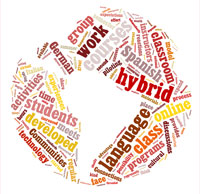
Hybrid language courses, made up of both online and classroom-based instruction, are growing at the University of Minnesota. French and Spanish are piloting refined second-year hybrid courses this semester, while German is piloting its first ever hybrid class this fall in 1003.
Spanish was the first to offer hybrid courses, starting with 1022 over a decade ago. Concentrated efforts to expand hybrid course development began in 2011, when Spanish created hybrid options for 1003 and 1004 and French piloted a hybrid version of 1004.
A Hybrid Working Group was formed during the Spring 2012 semester. It includes representatives from French, German, Italian, Spanish, the Language Center, CARLA and CLA-OIT. The goals of this group are to share resources, compare experiences and learn from one another without producing identical classes for various language programs.
The group worked diligently over the summer and continues to meet this semester. Meetings typically feature at least one technical training and exploration opportunity.
The new hybrid courses address the five national standards for foreign language learning, known as the "Five C's": Communication, Cultures, Comparisons, Connections, and Communities.
I sat down with Dan Soneson, coordinator of the Hybrid Working Group and spokesperson for ComSLE, to learn more about hybrid courses and the process of the work group's collaboration.
Saoirse: How are hybrid courses adjusted/customized to suit different languages? Is there a specific model for the ideal hybrid course?
Dan: It would be great if there were one model out there that we could all adopt, but the concept of a hybrid course has developed over time and only recently have we begun to think about actually replacing class time with time online. We started the process looking at how Spanish 1022 works, and went from there.
We quickly discovered that the amount and quality of prepared online resources available to Spanish is not as readily available to the other language programs, so French, German and Italian had to find and develop more of their own materials. While Spanish had begun with the intensive elementary course, both the French and German programs decided to start at the second year. The reasoning was that by the second year students have experience with the language and might be able to work more independently in a partially online context.
Saoirse: Will hybrid courses expand to more languages and levels in the future? Are there any more languages that may be experimenting with hybrid?
Dan: That will depend on the success of these newly developed courses. The original plan was to have blended learning or hybrid courses in place for at least semesters two through four of Spanish, German, French, and possibly Italian. If we can solidify the models we develop for these languages, perhaps they can serve as templates for related language programs.
Saoirse: Do you think a hybrid model would work with upper division language courses?
Dan: I definitely think a hybrid model can work throughout the curriculum. A great deal depends on what kinds of activities can be developed to take advantage of the wealth of material and communication possibilities that technology provides.
Saoirse: What are student's reactions to these new courses? Instructor's reactions?
Dan: As you can imagine, reactions have been mixed. One thing we've learned is that students discover quickly that this course involves more work than a strict face-to-face class, even though the expected time commitment is equivalent. While it may be possible to participate less in a face-to-face class, online you need to do all the work and demonstrate your participation. This work, however, can yield greater results, since everyone is participating equally.
Instructors also note the increased workload, primarily due to reading and responding to every student's contributions to forum topics and threaded discussions. However, regular classroom participation can increase as well. One instructor stated recently that once the class gets into the rhythm of online work leading to live classroom activities, the quality of the classroom work improves, with more engaged students and more stimulating discussions.
Saoirse: What are the expectations of a hybrid course? What are the characteristics of a student who will be successful in a hybrid course?
Dan: Basically, a hybrid course represents a transformation from a conventional course that meets exclusively in a physical space (a classroom) to one in which a regular number of classroom hours take place online or through use of technology. In our case, the conventional 5-credit course meets regularly at the same hour, five days each week. The hybrid version reduces the physical in-class hours to three each week, while the other two hours take place virtually, with students engaged with similar activities or with the kind of activities that are desirable, but difficult to accomplish in a large class setting.
The expectation is that these online "classes" carry the same weight as a regular in-class meeting, and that students spend at least 50 minutes focussing on the assigned activities, at a time that is convenient for them. In addition to these online activities, students also complete regular homework assignments for each class period, whether it is virtual or face-to-face.
Successful students are well organized self-starters who can work independently and are willing to work with peers outside of the classroom. Much of the "group" work that takes place in the virtual classroom requires teamwork and an ability to contribute to a discussion in a timely manner.
Saoirse: What are some things the Hybrid Work Group achieved over the summer? What kind of technology were instructors trained on?
Dan: The Work Group met weekly over the summer to share ideas and experiences. The idea was to provide both structure and a support system for all instructors working on the process. We had people from CLA-OIT participate and share technologies in an effort to help the instructors develop activities and format the courses. We experienced the capabilities of Moodle, Kaltura, UMConnect, Google Hangouts, TurnItIn, and Avenue.
One of the major opportunities that I see for hybrid courses is the ability to pair our students with speakers of the language they are learning. Our TandemPlus program is developing connections with institutions abroad, and ideally we can connect our learners with learners of English to engage in mutually beneficial regular exchanges in which each participant has an opportunity to discuss cultural issues with a partner in the target language.
Once we have these networks firmly established, our students could spend 50 minutes online with a language partner instead of in class. The possibility of using the language in meaningful communication in 50 minutes is much greater in this situation than in a large class. There is still much work to be done to bring these internet exchanges about in a regular manner, but it would be an excellent activity taking full advantage of what internet technology has to offer. Pilot programs are already underway in French, Spanish, German and Italian.
Saoirse: Is there anything else you would like to add about hybrid language courses in general?
Dan: This hybrid development process provides a great opportunity to rethink our language programs, to take advantage of the wealth of authentic materials available on the internet and the wonderful capabilities of Computer Mediated Communication, such as threaded discussions, chat, voice chat, and teleconferencing. You mentioned the National Standards above. We have an excellent opportunity now to address all five C's through technology, exploring Cultures, Connecting to disciplinary content, drawing Comparisons through in-depth experience of cultural practices and perspectives, and providing access to a vast array of Communities that function in the target language on the Web.
This is the first in a series of articles planned on hybrid course development. Look for future blog entries concentrating on hybrid courses for Spanish, French and German.
Friday, September 30, 2011
Green Germany and World Languages Day: An Interview with Beth Kautz
Over the past year, a Green German project has sprouted and continues to grow. A four-person team, including a faculty member, an instructor, one undergraduate and one graduate student has developed course materials for 3xxx-level German courses, and learning modules for high school German classes.
In Spring 2012, Dr. Charlotte Melin will offer a new German-language course Contemporary Germany: Food, Energy, Politics, that students can use towards the completion of a Minor in Sustainability Studies as well as a Major or Minor in German.
 Beth Kautz, Director of Language Instruction in GSD and liaison to the CLA Language Center, piloted some of this course content at World Languages Day (WLD) on May 17, 2011, with a short Green Germany class for high school students. German students from Lincoln High, in Thief River Falls, Minnesota attended this course virtually through AdobeConnect. The class was offered three times, and for two of the class periods, only virtual students attended but one class was a mix of 50% virtual students, and 50% in-person students (not from Lincoln).
By offering this course at WLD before the U of M credit-course is offered, Beth was able to acquire feedback from the students on their engagement with the material, as well as feedback on the effectiveness of the virtual course teaching methodology. The students' reactions to this course will be extremely beneficial for the continuing development of the Green German course curriculum.
I asked Beth to further explain the project, how planning and teaching a class virtually was different from teaching in a traditional classroom setting, and what she gained from this virtual teaching experience.
How did the idea for a class focused on the environment and sustainability develop?
There are three factors that came together. First of all, there was a personal interest on the part of Dr. Melin and myself in topics related to the environment and sustainability. Secondly, the topic is and has been very important culturally, politically and economically in Germany for decades. Finally, this type of course is a step toward offering more courses at the university that integrate foreign languages and cultures into various disciplines and content areas, a program known as FLAC (Foreign Languages Across the Curriculum).
How will a knowledge of the German language benefit those who wish to pursue a career in environmental science and sustainability studies
Germany is a world leader in research, development and use of renewable energies, including solar, wind and bio-mass power. There also are German architectural firms that consult all over the world on urban planning and design. Our students can help bring that knowledge to American companies and communities investing in green technologies and sustainability initiatives at the local, regional and national level.
How is the process of planning a virtual class different from planning a regular class?
By far the most difficult aspect is structuring opportunities to get feedback from the virtual participants. In a face-to-face classroom environment, I really heavily on visual cues and body language to gauge how well my students understand me or the task I have asked them to complete. When I see that students need help, I can walk over to them and address their concerns verbally with the support of gestures. In the virtual classroom, I made use of "polls," similar to a clicker-response system and group responses on the virtual whiteboard to get feedback from students.
How did you engage the virtual students, and insure that they didn't feel they were simply on the receiving end of a lecture?
In this virtual course, all the participants were together in one classroom in Thief River Falls along with their regular German teacher. I was the only one physically separated from the larger group. For several activities, I introduced a short video clip and discussion questions, which they then watched and discussed in small groups face-to-face in their classroom. After 10 minutes, we established contact again and they shared their insights with me and the whole group through a multiple-choice poll or written text on the group whiteboard.
What did you learn from this experience that will inform the development of the German credit course?
In the virtual class I taught, I used a variety of authentic German materials from the internet. These online materials are extremely helpful not only in explaining the basic concepts of sustainability, but also provide a very rich cultural context for exploring how concerns about food safety, the maintenance of nuclear power plants, the preservation of urban green-spaces, etc. play themselves out throughout society. As our project has progressed, we have continued to compile an extensive set of web links to videos, websites, images and interviews for 15 different learning modules. Through Title VI funding from CARLA, these materials also will be available to high school and university instructors throughout the country.
What piece of advice would you give an instructor interested in planning a virtual or hybrid class?
Keep your learning objectives at the forefront of your lesson planning. Ask yourself the same questions you would when planning any lesson: "What should students know or be able to do at the end of the lesson?" "How will I know that they learned it?" "What kind of support, information and instructions to students need before, during and after to successfully complete the task?" Then you need to think about which online tools best facilitate each of the those activities. In general, it requires more advance planning and preparation so that all the resources are available to students online and instructions are clearly understood without additional verbal explanation.
Thank you to Teran Pederson-Linn, recent CLA graduate and former Language Center staff member, for her work on this article.
For more information on World Languages Day, see this summary of the 2011 event.
In Spring 2012, Dr. Charlotte Melin will offer a new German-language course Contemporary Germany: Food, Energy, Politics, that students can use towards the completion of a Minor in Sustainability Studies as well as a Major or Minor in German.
Beth Kautz, Director of Language Instruction in GSD and liaison to the CLA Language Center, piloted some of this course content at World Languages Day (WLD) on May 17, 2011, with a short Green Germany class for high school students. German students from Lincoln High, in Thief River Falls, Minnesota attended this course virtually through AdobeConnect. The class was offered three times, and for two of the class periods, only virtual students attended but one class was a mix of 50% virtual students, and 50% in-person students (not from Lincoln).By offering this course at WLD before the U of M credit-course is offered, Beth was able to acquire feedback from the students on their engagement with the material, as well as feedback on the effectiveness of the virtual course teaching methodology. The students' reactions to this course will be extremely beneficial for the continuing development of the Green German course curriculum.
I asked Beth to further explain the project, how planning and teaching a class virtually was different from teaching in a traditional classroom setting, and what she gained from this virtual teaching experience.
How did the idea for a class focused on the environment and sustainability develop?
There are three factors that came together. First of all, there was a personal interest on the part of Dr. Melin and myself in topics related to the environment and sustainability. Secondly, the topic is and has been very important culturally, politically and economically in Germany for decades. Finally, this type of course is a step toward offering more courses at the university that integrate foreign languages and cultures into various disciplines and content areas, a program known as FLAC (Foreign Languages Across the Curriculum).
How will a knowledge of the German language benefit those who wish to pursue a career in environmental science and sustainability studies
Germany is a world leader in research, development and use of renewable energies, including solar, wind and bio-mass power. There also are German architectural firms that consult all over the world on urban planning and design. Our students can help bring that knowledge to American companies and communities investing in green technologies and sustainability initiatives at the local, regional and national level.
How is the process of planning a virtual class different from planning a regular class?
By far the most difficult aspect is structuring opportunities to get feedback from the virtual participants. In a face-to-face classroom environment, I really heavily on visual cues and body language to gauge how well my students understand me or the task I have asked them to complete. When I see that students need help, I can walk over to them and address their concerns verbally with the support of gestures. In the virtual classroom, I made use of "polls," similar to a clicker-response system and group responses on the virtual whiteboard to get feedback from students.
How did you engage the virtual students, and insure that they didn't feel they were simply on the receiving end of a lecture?
In this virtual course, all the participants were together in one classroom in Thief River Falls along with their regular German teacher. I was the only one physically separated from the larger group. For several activities, I introduced a short video clip and discussion questions, which they then watched and discussed in small groups face-to-face in their classroom. After 10 minutes, we established contact again and they shared their insights with me and the whole group through a multiple-choice poll or written text on the group whiteboard.
What did you learn from this experience that will inform the development of the German credit course?
In the virtual class I taught, I used a variety of authentic German materials from the internet. These online materials are extremely helpful not only in explaining the basic concepts of sustainability, but also provide a very rich cultural context for exploring how concerns about food safety, the maintenance of nuclear power plants, the preservation of urban green-spaces, etc. play themselves out throughout society. As our project has progressed, we have continued to compile an extensive set of web links to videos, websites, images and interviews for 15 different learning modules. Through Title VI funding from CARLA, these materials also will be available to high school and university instructors throughout the country.
What piece of advice would you give an instructor interested in planning a virtual or hybrid class?
Keep your learning objectives at the forefront of your lesson planning. Ask yourself the same questions you would when planning any lesson: "What should students know or be able to do at the end of the lesson?" "How will I know that they learned it?" "What kind of support, information and instructions to students need before, during and after to successfully complete the task?" Then you need to think about which online tools best facilitate each of the those activities. In general, it requires more advance planning and preparation so that all the resources are available to students online and instructions are clearly understood without additional verbal explanation.
Thank you to Teran Pederson-Linn, recent CLA graduate and former Language Center staff member, for her work on this article.
For more information on World Languages Day, see this summary of the 2011 event.
Wednesday, February 2, 2011
iTeach Workshop - Feb 17 - Creating Accessible Course Materials
Creating Accessible Course Materials
Language instructors are constantly creating new course materials to make use of authentic resources. We create Word Documents and PDFs, and upload countless images into our Moodle course websites. But how often do we think about the accessibility of the materials we create? For many of us, it's probably not something in the forefront of our minds. Thankfully, the University of Minnesota has a new web resource - accessibility.umn.edu - to help instructors improve the accessibility of their course materials for the widest possible audience, regardless of ability. Please join us as Phil Kragnes of Disability Services and the Office of Information Technology shows us simple ways to improve the accessibility of the materials we create for our students.
Creating Accessible Course Materials
Presenter: Phil Kragnes, U of M Disability Services and OIT
Thursday, February 17
12:20 - 1:10 pm
Jones 35
For more information about the topic of accessibility in education, see these recent articles from The Chronicle of Higher Ed:
Universal Design, Usability, and Accessibility
ADA Compliance is a 'Major Vulnerability' for Online Education Programs
Colleges Lock Out Blind Students Online
Language instructors are constantly creating new course materials to make use of authentic resources. We create Word Documents and PDFs, and upload countless images into our Moodle course websites. But how often do we think about the accessibility of the materials we create? For many of us, it's probably not something in the forefront of our minds. Thankfully, the University of Minnesota has a new web resource - accessibility.umn.edu - to help instructors improve the accessibility of their course materials for the widest possible audience, regardless of ability. Please join us as Phil Kragnes of Disability Services and the Office of Information Technology shows us simple ways to improve the accessibility of the materials we create for our students.
Creating Accessible Course Materials
Presenter: Phil Kragnes, U of M Disability Services and OIT
Thursday, February 17
12:20 - 1:10 pm
Jones 35
For more information about the topic of accessibility in education, see these recent articles from The Chronicle of Higher Ed:
Universal Design, Usability, and Accessibility
ADA Compliance is a 'Major Vulnerability' for Online Education Programs
Colleges Lock Out Blind Students Online
Subscribe to:
Posts (Atom)