Students interested in pursuing the Spanish Certificate of Advanced-Level Proficiency are invited to attend an orientation session on Friday, March 14, 3:00-4:30 p.m. in Jones 15 to learn more about this certificate and and ask questions. There will also be an opportunity to take the self-assessment instrument. Testing and Advising staff will be on hand to help students interpret their results.
Registration for the event is not required. However, potential candidates for the certificate are encouraged to fill out this short form to be informed of upcoming events and opportunities.

Showing posts with label Spanish. Show all posts
Showing posts with label Spanish. Show all posts
Monday, February 10, 2014
Monday, January 13, 2014
Spanish Advanced-Level Certificate Orientation and Workshop
Students interested in pursuing the Spanish Certificate of Advanced-Level Proficiency are invited to come to an orientation session on Wednesday, January 22, 2014, 3:00-4:30 p.m. in Jones 35 to learn more about this certificate and and ask questions. There will also be an opportunity to take the self-assessment instrument. Testing and Advising staff will be on hand to help students interpret their results.
Registration for the event is not required. However, potential candidates for the certificate are encouraged to fill out this short form to be informed of upcoming events and opportunities.
A second Orientation and Workshop will be held on March 14, 2014, 3:00-4:30 p.m. in Jones Hall room 10.
Registration for the event is not required. However, potential candidates for the certificate are encouraged to fill out this short form to be informed of upcoming events and opportunities.
A second Orientation and Workshop will be held on March 14, 2014, 3:00-4:30 p.m. in Jones Hall room 10.
Tuesday, January 7, 2014
Advanced-Level Spanish Certificate Option Approved for Students
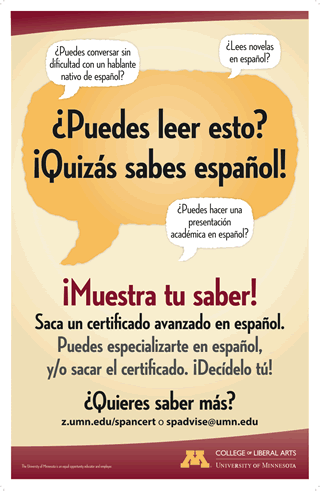
The Certificate of Advanced-Level Proficiency in Spanish program was recently approved as an option for students to have their language proficiency formally recognized beyond the Language Proficiency Exam (LPE). This is a great option for students of Spanish whose abilities extend beyond the intermediate level and who want to have their advanced-level proficiency formally recognized.
The Advanced-Level Certificate option is open to all undergraduate University of Minnesota students, regardless of their major or college. The certificate program will be administered jointly by the Department of Spanish and Portuguese Studies and the CLA Language Center.
The LPE can assess language proficiency skills up to the intermediate level. The Advanced-Level Spanish Certificate program will be able to assess skills up to the advanced level. The American Council on the Teaching of Foreign Language (ACTFL) guidelines determine advanced-level proficiency. According to these guidelines, students with advanced-level proficiency do not necessarily perform like native speakers. However, they have reading, writing, listening and speaking skills sufficient enough to navigate daily situations, such as routine school and work requirements and can be generally understood by native speakers.
One of the goals of the Certificate Program is to provide students with an internationally-recognized marker of proficiency once they achieve advanced-level proficiency. Another goal is: "To encourage the integration of language and culture learning across students' academic and professional lives, and empower students to be responsible for their own second language acquisition."1
There are several steps required for completing the Advanced-Level certificate, including: passing the Spanish LPE, passing two approved upper-level courses taught in Spanish, completing an intensive Spanish language immersion experience, taking a self-assessment, completing a critical reflection essay, and passing the ACTFL advanced-level exam. Please see the Advanced-Level Certificate informational website for a full list of requirements.
Students interested in learning more about the certificate are encouraged to attend a Certificate Orientation and Self-Assessment Workshop on January 22, 2014 from 3:00-4:30 p.m. in Jones 35. Information about the certificate is also available at http://z.umn.edu/spancert.
Monday, November 25, 2013
Spanish Students: Help pilot a new resource and receive a free gift certificate!
December 11, 2013, 3:00-4:30 p.m., Jones 35
The Spanish and Portuguese Studies department and the Language Testing Program are collaborating on a new resource to help students assess their own Spanish language abilities, called an Advanced-Level Self-Assessment Instrument. It is intended for Spanish majors and other students in higher-level courses to help them understand and describe their own abilities.
The Advanced-Level Self-Assessment Instrument will be piloted for the first time on December 11, 2013. We are looking for Spanish students to help us improve the instrument by coming to a workshop, completing the assessment, and providing feedback to the developers. We are particularly interested in receiving feedback from Senior Spanish major students.
All students who help pilot the assessment will receive a $20 gift certificate to their choice of the University Bookstore or Bordertown Coffee as a thank you for their participation.
Registration of interest is required. Space is limited, and priority will be given to Senior Spanish major students. If you are interested, please submit this interest form by Friday, December 7, 2013. You will be informed the following Monday if we are able to accommodate you at the event. If we are not able to accommodate you at this first pilot, don't worry, there will be additional opportunities to take the self-assessment during Spring 2014.
Please keep in mind that this is a pilot of the assessment instrument. Your participation will help us to refine the instrument and make it even more useful to advanced-level Spanish students.
The Spanish and Portuguese Studies department and the Language Testing Program are collaborating on a new resource to help students assess their own Spanish language abilities, called an Advanced-Level Self-Assessment Instrument. It is intended for Spanish majors and other students in higher-level courses to help them understand and describe their own abilities.
The Advanced-Level Self-Assessment Instrument will be piloted for the first time on December 11, 2013. We are looking for Spanish students to help us improve the instrument by coming to a workshop, completing the assessment, and providing feedback to the developers. We are particularly interested in receiving feedback from Senior Spanish major students.
All students who help pilot the assessment will receive a $20 gift certificate to their choice of the University Bookstore or Bordertown Coffee as a thank you for their participation.
Registration of interest is required. Space is limited, and priority will be given to Senior Spanish major students. If you are interested, please submit this interest form by Friday, December 7, 2013. You will be informed the following Monday if we are able to accommodate you at the event. If we are not able to accommodate you at this first pilot, don't worry, there will be additional opportunities to take the self-assessment during Spring 2014.
Please keep in mind that this is a pilot of the assessment instrument. Your participation will help us to refine the instrument and make it even more useful to advanced-level Spanish students.
Monday, August 5, 2013
TandemPlus Summer Update
The TandemPlus summer session is coming to an end. With the registration for summer now closed, and virtually all possible matches completed, Tandem matched 63% of interested students, and served a total of 149 participants. The most commonly matched languages were English & Spanish and English & Japanese.
The most common partner requests were English speakers seeking Spanish speakers, Chinese speakers seeking English speakers, and Arabic speakers seeking English speakers. Unfortunately, few Arabic language students registered this summer, although we did see an increase in Chinese language learners. We hope to see this number increase in the coming year. In other words, if you are learning Arabic or Chinese, please sign up for TandemPlus!
The most common partner requests were English speakers seeking Spanish speakers, Chinese speakers seeking English speakers, and Arabic speakers seeking English speakers. Unfortunately, few Arabic language students registered this summer, although we did see an increase in Chinese language learners. We hope to see this number increase in the coming year. In other words, if you are learning Arabic or Chinese, please sign up for TandemPlus!
Wednesday, February 20, 2013
Spotlight on Spanish Hybrid Courses
This is a continuation of a series of articles on hybrid courses. The series began with an interview with Dan Soneson, who coordinates the Hybrid Working Group.
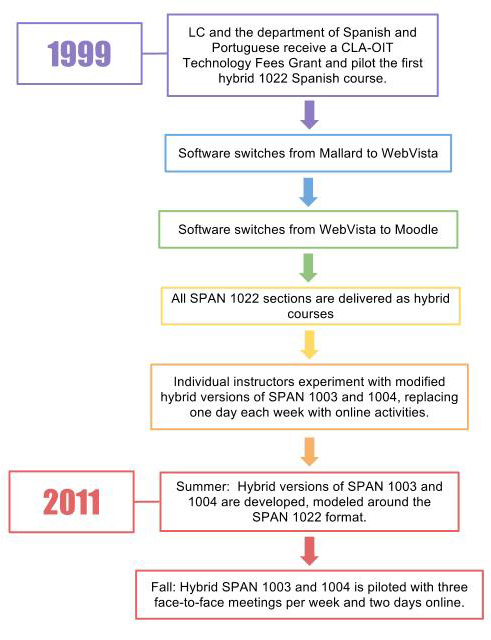
Spanish hybrid courses first launched in academic year 1999-2000, when the Spanish and Portuguese Studies department and the Language Center received a CLA-OIT Technology Fees Grant to create a hybrid version of 1022. At that time, the format was known as "technology enhanced," and was one option for students taking the intensive first-year Spanish course.
Today all sections of SPAN 1022 are technology enhanced. In this 5-credit class students meet face-to-face three days each week and do online and computer mediated activities instead of meeting physically two days each week.
Frances Matos-Schultz, the 1022 Level Coordinator, has managed and adapted the course since its debut. The course has changed considerably over time, as Frances and her fellow instructors learned from experience, and as technology tools have changed.
Spanish is unique among languages at the University of Minnesota in that it offers hybrid courses for introductory students at the 1022 level. Until recently, the hybrid format was restricted to SPAN 1022. While individual instructors in Spanish have experimented with modified hybrid formats in SPAN 1003 and 1004, replacing one day each week with online activities, a concerted effort to create hybrid versions of 1003 and 1004 along the lines SPAN 1022 was undertaken in the summer of 2011. Spanish piloted 1003 and 1004 as hybrid with three physical meetings and two days of online activities each week in Fall 2011.
The introduction of new Spanish 1003 and 1004 levels of hybrid has been generally painless for learners. Students who had taken SPAN 1022 were already familiar with the format. However, for students who tested into 1003 or 1004 hybrid courses or transfer students, it may have required some adjustment.
Sara Mack, the new Spanish 1004 coordinator, described a smooth implementation of the hybrid format as a goal to serve students. "One of the challenges going forward is to find the best way to provide support so that everyone, regardless of their comfort level with the Hybrid model or with technology in general, can achieve his or her language learning goals and be successful in the Hybrid 1004 class."
One of the possible adjustments students should make when taking the hybrid class is to make sure they treat the online portion of the course as seriously as the face-to-face meeting so that they are fully prepared and can perform well in class.
For the most part, online aspects seem to have helped students. "Students come better prepared to class. Research shows that students who engage with materials online come better prepared to the classroom, thus making better use of the face-to-face time," said Pablo Viedma, Spanish and Portuguese liaison.
Some unique advantages of the Spanish hybrid courses in lieu of traditional face-to-face format include online activities such as group writing exchanges, Moodle homework, Wimba Voice Board, and the Tertulias designed by France Matos Schultz and Megan Corbin. These activities allow students to interact more fully with the course content.
"They engage with this format, see relevant videos about it, converse in forum groups, create voice recordings and write short compositions about topics related to each chapter," said Angela Carlson-Lombardi, Spanish 1003 coordinator.
In hybrid versions of Spanish courses, writing exchanges and feedback occur online, where students can practice grammar, conversation, reading, and writing.
The hybrid format also allows Spanish students flexibility and can accommodate different types of learners. "Students engage with the materials when they are alert, which might be at different times than class times," Viedma noted. "Also, hybrid classes are known to engage diverse learners (introverted learners, for instance). We teach the students the same way that they interact with each other and with the media: through the computer, smartphone or tablet."
Students who are self-motivated learners and have sufficient time management skills are most likely to perform well in a hybrid course.
In the future, instructors are trying to ensure equality among the different formats of hybrid courses and access to materials. "The online modules also ensure students come prepared for the class, which is what we would like to ensure via online assignment for all of our classes," Carlson-Lombardi said.
At the 1022 level, three online learning modules are currently being updated. "In my sections I have been using additional modules connected to other disciplines," Matos-Schultz said. "I am currently working on them with my students (they provide valuable feedback and are amazing sources of creativity)."
Mack highlighted some core goals that are maintained for all language courses: "As we move forward, I think our goals remain the same as they always have been: to give our students the best language learning experience possible regardless of the format of the class, and to help students understand language and culture as a core part of a liberal arts education."
Spanish hybrid courses first launched in academic year 1999-2000, when the Spanish and Portuguese Studies department and the Language Center received a CLA-OIT Technology Fees Grant to create a hybrid version of 1022. At that time, the format was known as "technology enhanced," and was one option for students taking the intensive first-year Spanish course.
Today all sections of SPAN 1022 are technology enhanced. In this 5-credit class students meet face-to-face three days each week and do online and computer mediated activities instead of meeting physically two days each week.
Frances Matos-Schultz, the 1022 Level Coordinator, has managed and adapted the course since its debut. The course has changed considerably over time, as Frances and her fellow instructors learned from experience, and as technology tools have changed.
Spanish is unique among languages at the University of Minnesota in that it offers hybrid courses for introductory students at the 1022 level. Until recently, the hybrid format was restricted to SPAN 1022. While individual instructors in Spanish have experimented with modified hybrid formats in SPAN 1003 and 1004, replacing one day each week with online activities, a concerted effort to create hybrid versions of 1003 and 1004 along the lines SPAN 1022 was undertaken in the summer of 2011. Spanish piloted 1003 and 1004 as hybrid with three physical meetings and two days of online activities each week in Fall 2011.
Adjusting to Hybrid Spanish Courses
The introduction of new Spanish 1003 and 1004 levels of hybrid has been generally painless for learners. Students who had taken SPAN 1022 were already familiar with the format. However, for students who tested into 1003 or 1004 hybrid courses or transfer students, it may have required some adjustment.
Only half of the 1003 and 1004 hybrid instructors had previously taught 1022 courses, Matos-Schultz said, so the move to hybrid for these instructors was more involved and may have been challenging:
"The move from a fully F2F environment to a hybrid (3+2) format was more involved and perhaps a bit more challenging for the instructors that were completely new to hybrid teaching, even though they were experienced and very successful 1003 and 1004 instructors. It required a repositioning of the instructor/learner roles, redesigning lesson plans, rethinking feedback techniques and strategies online and extending the teaching presence online. It was certainly hard work." - Frances Matos-Schultz
Sara Mack, the new Spanish 1004 coordinator, described a smooth implementation of the hybrid format as a goal to serve students. "One of the challenges going forward is to find the best way to provide support so that everyone, regardless of their comfort level with the Hybrid model or with technology in general, can achieve his or her language learning goals and be successful in the Hybrid 1004 class."
One of the possible adjustments students should make when taking the hybrid class is to make sure they treat the online portion of the course as seriously as the face-to-face meeting so that they are fully prepared and can perform well in class.
For the most part, online aspects seem to have helped students. "Students come better prepared to class. Research shows that students who engage with materials online come better prepared to the classroom, thus making better use of the face-to-face time," said Pablo Viedma, Spanish and Portuguese liaison.
What Makes Spanish Hybrid Unique?
Some unique advantages of the Spanish hybrid courses in lieu of traditional face-to-face format include online activities such as group writing exchanges, Moodle homework, Wimba Voice Board, and the Tertulias designed by France Matos Schultz and Megan Corbin. These activities allow students to interact more fully with the course content.
"They engage with this format, see relevant videos about it, converse in forum groups, create voice recordings and write short compositions about topics related to each chapter," said Angela Carlson-Lombardi, Spanish 1003 coordinator.
In hybrid versions of Spanish courses, writing exchanges and feedback occur online, where students can practice grammar, conversation, reading, and writing.
The hybrid format also allows Spanish students flexibility and can accommodate different types of learners. "Students engage with the materials when they are alert, which might be at different times than class times," Viedma noted. "Also, hybrid classes are known to engage diverse learners (introverted learners, for instance). We teach the students the same way that they interact with each other and with the media: through the computer, smartphone or tablet."
Advice for Students, Instructors and Developers
Students who are self-motivated learners and have sufficient time management skills are most likely to perform well in a hybrid course.
Matos-Schultz emphasized the importance of community, patience, and humor when adjusting to hybrid.
"[It's important] to be patient and adventurous with the technology. A good sense of humor is essential. Keep in mind that "going hybrid" is a process that takes time. Trial and error are part of it. Engage your community in the process, particularly your learners. Remember that instructors need support too. Make sure to include a space for learners to create community. An instructor's community of practitioners (and supporters!) is crucial as well." - Frances Matos-Schultz
Goals for Spanish Hybrid Going Forward
In the future, instructors are trying to ensure equality among the different formats of hybrid courses and access to materials. "The online modules also ensure students come prepared for the class, which is what we would like to ensure via online assignment for all of our classes," Carlson-Lombardi said.
At the 1022 level, three online learning modules are currently being updated. "In my sections I have been using additional modules connected to other disciplines," Matos-Schultz said. "I am currently working on them with my students (they provide valuable feedback and are amazing sources of creativity)."
Mack highlighted some core goals that are maintained for all language courses: "As we move forward, I think our goals remain the same as they always have been: to give our students the best language learning experience possible regardless of the format of the class, and to help students understand language and culture as a core part of a liberal arts education."
Monday, December 10, 2012
Spanish 1004 LPE: Reading, Listening and Writing Now Completely Online
The Language Proficiency Exam (LPE) is integrated into the fourth-semester courses of many languages. Students in fourth-semester Spanish take the reading, listening and writing portions of the LPE during regular class periods, and beginning Fall 2012, they are the first language classes to take the three parts of the LPE online. Until now, the LPE reading and listening have been taken online as the final exam. However, the LPE writing test was still on paper in the students' classroom. The writing section is rated by instructors, whereas the the reading and listening sections are computer-graded.
Last week all students in Spanish 1004, 1014, and 1044 came to Jones Hall during a regular class period to take the LPE writing test online in one of the computer labs. This change is possible due to upgrades to the online LPE delivery system that allow students' exams to be linked to a specific course section. This means for example, that all exams taken by Spanish 1004-006 students can be linked for grading purposes. When the new system is fully implemented, instructors will be able pull up student exams by section through the grader interface and evaluate the individual tests.
Last week all students in Spanish 1004, 1014, and 1044 came to Jones Hall during a regular class period to take the LPE writing test online in one of the computer labs. This change is possible due to upgrades to the online LPE delivery system that allow students' exams to be linked to a specific course section. This means for example, that all exams taken by Spanish 1004-006 students can be linked for grading purposes. When the new system is fully implemented, instructors will be able pull up student exams by section through the grader interface and evaluate the individual tests.
Thursday, November 29, 2012
Hybrid Language Courses Expand
Hybrid language courses, made up of both online and classroom-based instruction, are growing at the University of Minnesota. French and Spanish are piloting refined second-year hybrid courses this semester, while German is piloting its first ever hybrid class this fall in 1003.
Spanish was the first to offer hybrid courses, starting with 1022 over a decade ago. Concentrated efforts to expand hybrid course development began in 2011, when Spanish created hybrid options for 1003 and 1004 and French piloted a hybrid version of 1004.
A Hybrid Working Group was formed during the Spring 2012 semester. It includes representatives from French, German, Italian, Spanish, the Language Center, CARLA and CLA-OIT. The goals of this group are to share resources, compare experiences and learn from one another without producing identical classes for various language programs.
The group worked diligently over the summer and continues to meet this semester. Meetings typically feature at least one technical training and exploration opportunity.
The new hybrid courses address the five national standards for foreign language learning, known as the "Five C's": Communication, Cultures, Comparisons, Connections, and Communities.
I sat down with Dan Soneson, coordinator of the Hybrid Working Group and spokesperson for ComSLE, to learn more about hybrid courses and the process of the work group's collaboration.
Saoirse: How are hybrid courses adjusted/customized to suit different languages? Is there a specific model for the ideal hybrid course?
Dan: It would be great if there were one model out there that we could all adopt, but the concept of a hybrid course has developed over time and only recently have we begun to think about actually replacing class time with time online. We started the process looking at how Spanish 1022 works, and went from there.
We quickly discovered that the amount and quality of prepared online resources available to Spanish is not as readily available to the other language programs, so French, German and Italian had to find and develop more of their own materials. While Spanish had begun with the intensive elementary course, both the French and German programs decided to start at the second year. The reasoning was that by the second year students have experience with the language and might be able to work more independently in a partially online context.
Saoirse: Will hybrid courses expand to more languages and levels in the future? Are there any more languages that may be experimenting with hybrid?
Dan: That will depend on the success of these newly developed courses. The original plan was to have blended learning or hybrid courses in place for at least semesters two through four of Spanish, German, French, and possibly Italian. If we can solidify the models we develop for these languages, perhaps they can serve as templates for related language programs.
Saoirse: Do you think a hybrid model would work with upper division language courses?
Dan: I definitely think a hybrid model can work throughout the curriculum. A great deal depends on what kinds of activities can be developed to take advantage of the wealth of material and communication possibilities that technology provides.
Saoirse: What are student's reactions to these new courses? Instructor's reactions?
Dan: As you can imagine, reactions have been mixed. One thing we've learned is that students discover quickly that this course involves more work than a strict face-to-face class, even though the expected time commitment is equivalent. While it may be possible to participate less in a face-to-face class, online you need to do all the work and demonstrate your participation. This work, however, can yield greater results, since everyone is participating equally.
Instructors also note the increased workload, primarily due to reading and responding to every student's contributions to forum topics and threaded discussions. However, regular classroom participation can increase as well. One instructor stated recently that once the class gets into the rhythm of online work leading to live classroom activities, the quality of the classroom work improves, with more engaged students and more stimulating discussions.
Saoirse: What are the expectations of a hybrid course? What are the characteristics of a student who will be successful in a hybrid course?
Dan: Basically, a hybrid course represents a transformation from a conventional course that meets exclusively in a physical space (a classroom) to one in which a regular number of classroom hours take place online or through use of technology. In our case, the conventional 5-credit course meets regularly at the same hour, five days each week. The hybrid version reduces the physical in-class hours to three each week, while the other two hours take place virtually, with students engaged with similar activities or with the kind of activities that are desirable, but difficult to accomplish in a large class setting.
The expectation is that these online "classes" carry the same weight as a regular in-class meeting, and that students spend at least 50 minutes focussing on the assigned activities, at a time that is convenient for them. In addition to these online activities, students also complete regular homework assignments for each class period, whether it is virtual or face-to-face.
Successful students are well organized self-starters who can work independently and are willing to work with peers outside of the classroom. Much of the "group" work that takes place in the virtual classroom requires teamwork and an ability to contribute to a discussion in a timely manner.
Saoirse: What are some things the Hybrid Work Group achieved over the summer? What kind of technology were instructors trained on?
Dan: The Work Group met weekly over the summer to share ideas and experiences. The idea was to provide both structure and a support system for all instructors working on the process. We had people from CLA-OIT participate and share technologies in an effort to help the instructors develop activities and format the courses. We experienced the capabilities of Moodle, Kaltura, UMConnect, Google Hangouts, TurnItIn, and Avenue.
One of the major opportunities that I see for hybrid courses is the ability to pair our students with speakers of the language they are learning. Our TandemPlus program is developing connections with institutions abroad, and ideally we can connect our learners with learners of English to engage in mutually beneficial regular exchanges in which each participant has an opportunity to discuss cultural issues with a partner in the target language.
Once we have these networks firmly established, our students could spend 50 minutes online with a language partner instead of in class. The possibility of using the language in meaningful communication in 50 minutes is much greater in this situation than in a large class. There is still much work to be done to bring these internet exchanges about in a regular manner, but it would be an excellent activity taking full advantage of what internet technology has to offer. Pilot programs are already underway in French, Spanish, German and Italian.
Saoirse: Is there anything else you would like to add about hybrid language courses in general?
Dan: This hybrid development process provides a great opportunity to rethink our language programs, to take advantage of the wealth of authentic materials available on the internet and the wonderful capabilities of Computer Mediated Communication, such as threaded discussions, chat, voice chat, and teleconferencing. You mentioned the National Standards above. We have an excellent opportunity now to address all five C's through technology, exploring Cultures, Connecting to disciplinary content, drawing Comparisons through in-depth experience of cultural practices and perspectives, and providing access to a vast array of Communities that function in the target language on the Web.
This is the first in a series of articles planned on hybrid course development. Look for future blog entries concentrating on hybrid courses for Spanish, French and German.
Tuesday, November 20, 2012
TandemPlus Roundup!
TandemPlus is pleased to announce that it has had a very successful fall semester! There was an approximate total of 481 language partnerships through Tandem's Face-to-Face Exchange program. The most popular language partnerships were Chinese seeking English, English seeking Spanish, and Arabic seeking English. There was also an exciting amount of Korean/English partnerships this year. It was a great fall semester and we are eager to start spring semester off on the right foot. Registration for TandemPlus this spring semester is expected to open during the first week of classes (late January).
Monday, November 5, 2012
TandemPlus Punch Pizza Party a Success!
We are pleased to say that the TandemPlus Pizza Party at Punch Pizza in Dinkytown on Friday, November 2 was a great success! Approximately 40 people showed up, enjoying pizza and great company while playing conversation games such as Taboo in Spanish, Korean, Chinese, and English. The next TandemPlus event is Small World Coffee Hour on November 30. Stay tuned for more details.
Thursday, October 25, 2012
The LPE Changes with the Times
The Language Testing Program now offers computerized Language Proficiency Exams (LPEs) in more languages than ever before. Tests currently in development feature culturally-rich authentic source material such as clips from modern Korean film, a look at the Somali-speaking community in the Twin Cities, and much more!
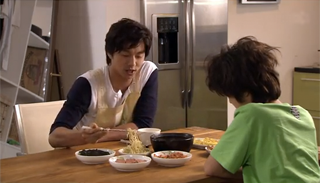
Example of culturally authentic material that could be used in LPE
Computerized LPEs were established in 2001. Hundreds of language students take them each semester to fulfill the College of Liberal Arts (CLA) language requirement and as a gateway to advanced language study. The mission of the Language Testing Program has remained constant: to accurately assess students' ability to listen, read, write and speak in the target language.
However, the program has changed and grown since 2001. The LPE is constantly being improved and the pace of modernization and innovation has picked up in the last few years. The Language Testing Program has focused on two new goals since 2010: to serve as many language students as possible and to improve the students' exam experience by including contemporary and diverse media from the target language culture.
Before 2010, a computerized test was available only for students of French, German and Spanish and a few related languages. Students of Asian and other less commonly taught languages were limited to paper-based tests, or had no exam options at all.
Tests are now in place for Arabic, Chinese, Hmong, Italian, Japanese and Russian, and there is a second version of the Spanish LPE. In addition, development is underway for Finnish, Korean, Somali, and Swahili. All of these tests were made possible through an influx of funding from Title VI and other sources, along with a committed effort on the part of the Language Testing Program and the individual language programs to work together tirelessly and collaboratively. Once all of the newer exams are completed, the LPE will be available for almost all non-Classical languages offered in CLA and will reflect the diversity of languages available at the University of Minnesota.
As new tests are created, the Language Testing Program and the developers aim to bring new depth to the student experience and to conform more closely to current trends in second language pedagogy with increased emphasis on culturally-rich contexts. The new exams retain the original LPE goal of validating the work of students in their four semesters at the university by providing an opportunity to show what they can do with the target language in a communicative context.
However, they are not just tests - they are also learning opportunities for students, highlighting something new about the culture, history, or people of the target language through the use of authentic materials. Students may learn, for example, how traditional holiday celebrations have changed over time as societies become increasingly multicultural. There are also explorations of how gender roles have shifted and how these shifts impact language as well as cultural practice. One exam features an innovative, and perhaps surprising, environmental initiative. Another explores the lyrics of a popular song from a YouTube video.
The piloting process for new LPEs often includes a survey of student opinions about the test. Reactions to the new authentic content have been overwhelmingly positive. Test-takers have said that they were surprised and pleased to see that they had no difficulty reading texts that they might encounter on a daily basis in the target culture.
The Korean LPE also offers a significant technological innovation: the incorporation of authentic video segments into the listening section. The test includes five diverse clips from modern Korean film showing natural and interesting interactions between native speakers. The use of authentic video is an excellent platform from which to assess listening proficiency, since it ties closely to the construct of listening in a communicative context, where meaning is negotiated based on a variety of input sources. The Korean listening exam has already been piloted once, and the response to the test was enthusiastically positive. Students reported that they especially enjoyed the video segments and felt confident that they could understand content overall, even though there may have been a few words unfamiliar to them.
The Somali listening section will include some authentic video segments as well. This exam stands out because it is set locally and explores the lives of immigrants integrating with the larger community as they share their language and culture - a reflection of the changing face of the Twin Cities.
Since 2010, new LPE creation has been led by Gabriela Sweet, who has worked tirelessly to organize a rotating team of developers, coordinate with multiple departments and stakeholders, and keep all projects on time and moving forward. The Korean, Somali, and Swahili development teams also include Language Center AV Developer Alaina Witt, Item Reviewers Xinyi Wu and Meghan McFadden, and LC Technical Coordinator Diane Rackowski.
Much of the funding for Korean development has been provided by a CLA InfoTech Tools for Discovery Grant. Title VI funding managed by the Institute for Global Studies has provided some travel and development grants for Somali and Swahili.
The Language Testing Program and the Department of Asian Languages and Literatures plan to present the new Korean listening section featuring authentic video later this winter. The U of M language community will have an opportunity to see how the classic LPE format can be modernized with technology to provide students with an educational, culturally-rich, and even enjoyable testing experience.
Example of culturally authentic material that could be used in LPE
However, the program has changed and grown since 2001. The LPE is constantly being improved and the pace of modernization and innovation has picked up in the last few years. The Language Testing Program has focused on two new goals since 2010: to serve as many language students as possible and to improve the students' exam experience by including contemporary and diverse media from the target language culture.
Before 2010, a computerized test was available only for students of French, German and Spanish and a few related languages. Students of Asian and other less commonly taught languages were limited to paper-based tests, or had no exam options at all.
Tests are now in place for Arabic, Chinese, Hmong, Italian, Japanese and Russian, and there is a second version of the Spanish LPE. In addition, development is underway for Finnish, Korean, Somali, and Swahili. All of these tests were made possible through an influx of funding from Title VI and other sources, along with a committed effort on the part of the Language Testing Program and the individual language programs to work together tirelessly and collaboratively. Once all of the newer exams are completed, the LPE will be available for almost all non-Classical languages offered in CLA and will reflect the diversity of languages available at the University of Minnesota.
As new tests are created, the Language Testing Program and the developers aim to bring new depth to the student experience and to conform more closely to current trends in second language pedagogy with increased emphasis on culturally-rich contexts. The new exams retain the original LPE goal of validating the work of students in their four semesters at the university by providing an opportunity to show what they can do with the target language in a communicative context.
However, they are not just tests - they are also learning opportunities for students, highlighting something new about the culture, history, or people of the target language through the use of authentic materials. Students may learn, for example, how traditional holiday celebrations have changed over time as societies become increasingly multicultural. There are also explorations of how gender roles have shifted and how these shifts impact language as well as cultural practice. One exam features an innovative, and perhaps surprising, environmental initiative. Another explores the lyrics of a popular song from a YouTube video.
The piloting process for new LPEs often includes a survey of student opinions about the test. Reactions to the new authentic content have been overwhelmingly positive. Test-takers have said that they were surprised and pleased to see that they had no difficulty reading texts that they might encounter on a daily basis in the target culture.
Here are some sample student reactions:
It made me realize the potential of a real-life usage for the language I've been studying.
I liked that the readings were all things I'd have to figure out in real life. It was a very pleasant experience to read articles from Japan.
I liked that the readings were all things I'd have to figure out in real life. It was a very pleasant experience to read articles from Japan.
The Korean LPE also offers a significant technological innovation: the incorporation of authentic video segments into the listening section. The test includes five diverse clips from modern Korean film showing natural and interesting interactions between native speakers. The use of authentic video is an excellent platform from which to assess listening proficiency, since it ties closely to the construct of listening in a communicative context, where meaning is negotiated based on a variety of input sources. The Korean listening exam has already been piloted once, and the response to the test was enthusiastically positive. Students reported that they especially enjoyed the video segments and felt confident that they could understand content overall, even though there may have been a few words unfamiliar to them.
The Somali listening section will include some authentic video segments as well. This exam stands out because it is set locally and explores the lives of immigrants integrating with the larger community as they share their language and culture - a reflection of the changing face of the Twin Cities.
Since 2010, new LPE creation has been led by Gabriela Sweet, who has worked tirelessly to organize a rotating team of developers, coordinate with multiple departments and stakeholders, and keep all projects on time and moving forward. The Korean, Somali, and Swahili development teams also include Language Center AV Developer Alaina Witt, Item Reviewers Xinyi Wu and Meghan McFadden, and LC Technical Coordinator Diane Rackowski.
The current language-specific developers are:
Finnish: Dan Karvonen, Jaana Viljakainen
Korean: Hangtae Cho, Yunseong Cheong
Somali: Said Ahmed, Abdulkarim Maalin
Swahili: Angaluki Muaka
Korean: Hangtae Cho, Yunseong Cheong
Somali: Said Ahmed, Abdulkarim Maalin
Swahili: Angaluki Muaka
Much of the funding for Korean development has been provided by a CLA InfoTech Tools for Discovery Grant. Title VI funding managed by the Institute for Global Studies has provided some travel and development grants for Somali and Swahili.
The Language Testing Program and the Department of Asian Languages and Literatures plan to present the new Korean listening section featuring authentic video later this winter. The U of M language community will have an opportunity to see how the classic LPE format can be modernized with technology to provide students with an educational, culturally-rich, and even enjoyable testing experience.
Monday, October 1, 2012
TandemPlus Kick-off a Huge Success
On Friday afternoon, September 28, TandemPlus hosted its Fall Kick-off and Orientation Event. Approximately 70 people attended the event, and played multilingual (Spanish-English, Arabic-English, Chinese-English, and just English) Taboo games, partook in multilingual conversation circles, and enjoyed snacks and refreshments. The event was open to TandemPlus participants and interested parties and was enjoyed by all. Stay tuned for more information about the next Tandem event in late October.
FYI -- there is still (some) time to register for a TandemPlus second language culture and conversation partner. Registration for Fall semester will close on Friday, October 5, so if you're interested in registering, do it soon!
FYI -- there is still (some) time to register for a TandemPlus second language culture and conversation partner. Registration for Fall semester will close on Friday, October 5, so if you're interested in registering, do it soon!
Monday, August 20, 2012
Welcome Francisco, New World Languages Day Assistant
Please welcome the new World Languages Day student assistant: Francisco Salinas Vega. He is a senior majoring in Applied Economics. He is also a native Spanish speaker born in Queretaro Mexico. Francisco believes that learning a new language provides a person with different perspectives, and he has experience with event planning and outreach to the Latino community.
As an update on our previous assistants: Bethany Schowengerdt completed her BA in Global Studies and French, and a minor in Teaching English as a Second Language. Over the summer she taught ESL and worked for AFS, a cultural exchange organization. She is currently preparing for her Fulbright English Teaching Assistant (ETA) grant to travel to Rwanda.
Rachel Faynik Marbell completed her MA in International Education this past May. She is now working as the France Programs Coordinator at Intercultural Student Experiences, a non-profit educational organization that helps high school language teachers plan short-term immersion programs abroad with their students. She is still involved with the University of Minnesota through her position as the Assistant Coach of the Hockey Cheerleading Team.
As an update on our previous assistants: Bethany Schowengerdt completed her BA in Global Studies and French, and a minor in Teaching English as a Second Language. Over the summer she taught ESL and worked for AFS, a cultural exchange organization. She is currently preparing for her Fulbright English Teaching Assistant (ETA) grant to travel to Rwanda.
Rachel Faynik Marbell completed her MA in International Education this past May. She is now working as the France Programs Coordinator at Intercultural Student Experiences, a non-profit educational organization that helps high school language teachers plan short-term immersion programs abroad with their students. She is still involved with the University of Minnesota through her position as the Assistant Coach of the Hockey Cheerleading Team.
Tuesday, August 7, 2012
TandemPlus and ESL at the St. Paul Saints Game
On Friday, July 27, TandemPlus co-hosted a night of baseball and fun with the Minnesota English Language Program. This is the first event co-hosted by these university programs and it was a great success! Both American and international students attended the Saint Paul Saints baseball game at Midway Stadium in St. Paul and spoke a variety of languages including Arabic, German, Japanese, Chinese, English and Spanish. Overall students had a great time and after 11 innings the Saints pulled through and won the game. The night ended with a spectacular fireworks show and celebration over the Saints win. We hope you will join us for our next event, and don't forget to mark your calendars -- Fall registration is less than a month away!
Tuesday, July 31, 2012
Welcome Bri, the new TandemPlus Assistant
We are pleased to welcome Brianna Lopez to the Tandem Plus team. Brianna, or Bri, is a junior at the University of Minnesota, majoring in English and minoring in Spanish and Gender, Women, and Sexuality Studies (GWSS). In the past she participated in a Spanish-English TandemPlus exchange and continues to pursue an interest in language learning and social justice. She looks forward to graduating in the spring of 2014 and hopes to pursue a career in international law. Stop by Jones 135A and say hello to her!
Monday, April 30, 2012
Branch out and Learn: The 2012 WLD Poster
This year's World Languages Day will feature sustainability-themed content courses for French, German and Spanish. The three classes are taught in the target language, and the classes are based on content recently developed for U of M language courses. See Elsie Speaks for more information on the university courses.
The World Languages Day courses are:
These classes will give high school students an opportunity to participate in a science-based content course taught in a second language.
These courses are highlighted on our 2012 poster, designed by Paul Fosaaen, our Multimedia Lab Lead Student, who is graduating at the end of this semester. Congratulations Paul!
In addition to designing the WLD poster, Paul is the artist of Mi Casta Su Casta, a piece hung in the Multimedia Lab.
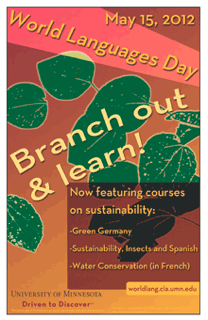
The World Languages Day courses are:
- French: Water Conservation and Ecology taught by Patricia Mougel
- German: Green Germany taught by Beth Kautz
- Spanish: Sustainability, Insects and Spanish taught by Frances Matos-Schultz
These classes will give high school students an opportunity to participate in a science-based content course taught in a second language.
These courses are highlighted on our 2012 poster, designed by Paul Fosaaen, our Multimedia Lab Lead Student, who is graduating at the end of this semester. Congratulations Paul!
In addition to designing the WLD poster, Paul is the artist of Mi Casta Su Casta, a piece hung in the Multimedia Lab.
Thursday, March 22, 2012
World Languages Day: Branch out and Learn!
While University of Minnesota students and faculty are counting down to various deadlines and the end of the semester, the World Languages Day planning committee continues the count-down to World Languages Day, and we can't wait! The event is scheduled for Tuesday, May 15, just two months away. We expect to draw over 1000 high school sophomores to campus.
This year, we are happy to see returning high schools from last year, from the Twin Cities metro area, as well as the northern, southern, and central areas of Minnesota. We also welcome new schools or schools that participated prior to 2011 representing a wide range of cities and town in Minnesota.
New teachers and students are in for a treat. Returnees will recognize perennial favorites on the course list, and will once again be able to learn traditional Hmong dance, greet each other in Italian, and play American Idol in German - and that's just the a small sampling of the offerings!
Reading over the course list is like flipping through a virtual travel catalogue, one that sparks cultural inquiry. Students can take Arabic Language and Culture: a Trip to Tunisia, Excursion Brazil, and A Virtual Walk through Vienna, all without leaving the U of M campus. For students who do want to leave campus, information on travel all over the world will be offered in three study abroad information sessions.
New this year will be the sounds of Afro-Cuban Music, a Spanish course which will include special musical guests. Experiencing the Chinese Language takes students on a journey through thousands of years of history. Classes such as the debut of From Atheists to Libertines: French Philosophy and the Limits of the Imagination challenge our assumptions in learning about other cultures and places, and the people we meet along the way.
There is also a cross-curriculum focus on sustainability offered this year: Water Conservation and Ecology (French), Sustainability, Insects, and Spanish, as well as Green Germany, each taught in the target language. Students will have the chance to apply their knowledge of science and the economy to their language studies in these different cultural contexts.
Take a look at our online course list for both new and proven ways to stretch imagination, broaden cultural knowledge, and express yourself in 23 different languages offered at World Languages Day this May.
In the meantime, the planning continues! Look out for more information on registration coming soon. You can view the class list, and learn more about the event at our website.
This year, we are happy to see returning high schools from last year, from the Twin Cities metro area, as well as the northern, southern, and central areas of Minnesota. We also welcome new schools or schools that participated prior to 2011 representing a wide range of cities and town in Minnesota.
New teachers and students are in for a treat. Returnees will recognize perennial favorites on the course list, and will once again be able to learn traditional Hmong dance, greet each other in Italian, and play American Idol in German - and that's just the a small sampling of the offerings!
Reading over the course list is like flipping through a virtual travel catalogue, one that sparks cultural inquiry. Students can take Arabic Language and Culture: a Trip to Tunisia, Excursion Brazil, and A Virtual Walk through Vienna, all without leaving the U of M campus. For students who do want to leave campus, information on travel all over the world will be offered in three study abroad information sessions.
New this year will be the sounds of Afro-Cuban Music, a Spanish course which will include special musical guests. Experiencing the Chinese Language takes students on a journey through thousands of years of history. Classes such as the debut of From Atheists to Libertines: French Philosophy and the Limits of the Imagination challenge our assumptions in learning about other cultures and places, and the people we meet along the way.
There is also a cross-curriculum focus on sustainability offered this year: Water Conservation and Ecology (French), Sustainability, Insects, and Spanish, as well as Green Germany, each taught in the target language. Students will have the chance to apply their knowledge of science and the economy to their language studies in these different cultural contexts.
Take a look at our online course list for both new and proven ways to stretch imagination, broaden cultural knowledge, and express yourself in 23 different languages offered at World Languages Day this May.
In the meantime, the planning continues! Look out for more information on registration coming soon. You can view the class list, and learn more about the event at our website.
Monday, March 5, 2012
Mackenzie Haws Wins Big Ten Network Award
Mackenzie, a Spanish student and Assistant Lead Student in the main office has won the 2012 Big Ten Network LiveBIG Scholarship for Outstanding Service award for her volunteer work in the Big Brothers Big Sisters program.
You can read about this awards, and see a picture of Mackenzie and her little sister with Goldie Gopher at UMNews.
You can read about this awards, and see a picture of Mackenzie and her little sister with Goldie Gopher at UMNews.
Friday, November 11, 2011
New student-created art in Jones 135: Mi Casta Su Casta
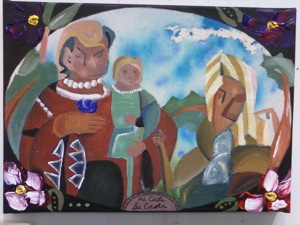
Lead Multimedia Lab Attendant and Art History major Paul Fosaaen donated a painting to the newly renovated multimedia lab, Jones 135, and it was recently hung. Here is an explanation of the piece from Paul:
Mi Casta Su Casta for me stands as a testament to the power of inclusiveness over bigotry and xenophobia. Painted initially as an assignment for class, the painting itself developed into a response against a tradition in Spanish painting that arose in the 17th and 18th centuries. Casta paintings served as an attempt for the Spanish aristocracy to retain 'purity' of Spanish blood during a time of expanded colonization of Mexico. These paintings documented potential racial and cultural mixtures, essentially to prove to the Spanish that they had retained racial and cultural supremacy over the indigenous people in their colonies. My use of abstraction in Mi Casta Su Casta is not merely to deny visible reality, but also it asserts a sense of unity to further reject the intensive pigeonholing that occurred in Spanish Casta paintings. When abstraction allows for the disappearance of racial divisiveness, it also permits us as viewers to dream of participating in this vision. Mi Casta Su Casta becomes more than just a rejection of historical misdeeds, but it is a family portrait in which we all belong. The title itself, a pun on the ubiquitous mi casa su casa, declares that 'your caste is my caste' and that 'my family is your family.' Instead of imposing segregation and highlighting pejorative differences, Mi Casta Su Casta extends an invitation to all families and all people so that we may all feel at home.
Mi Casta Su Casta 2011
Van Gauguin (Paul Fosaaen)
Acrylic on canvas
Friday, November 4, 2011
Sustainability and Language Acquisition: Different Approaches to Integrating Academic Content for Different Languages
When the French, German and Spanish language programs had the opportunity to collaborate on the creation of sustainability-themed content for their courses, they jumped right in. However, curriculum developers from the three programs had a different visions for how the content would ultimately be integrated into their university languages courses.
This spring semester, University of Minnesota language students will have several new opportunities to learn about sustainability at the same time as they continue second language acquisition.
Part of the curriculum development was funded by Title VI to create Foreign Languages Across the Curriculum Content (FLAC) resources for K-12 and university courses. The team working to get these initiatives off the ground is:
Elaine Tarone (CARLA)
Patricia Mougel (French)
Charlotte Melin and Beth Kautz (German)
Susan Villar and Frances Matos-Schultz (Spanish).
Here is an overview of the two approaches the programs took for integrating academic content with second language acquisition, focusing on examples of classes offered Spring 2012:
French and German: Upper-level course enhancement and redesign
FREN 3022 The Language and Culture of Business in France
GER 3501 Contemporary Germany: Environmental Debates--Food, Energy, Politics
Patricia is currently teaching her French advanced oral communication class as a new content-based language course on the theme of water. For Spring 2012, Patricia is revamping her ongoing business course, integrating new content on sustainability while keeping the focus on business overall. In the course students will learn about and discuss sustainable business practices in France through case studies of businesses that have moved towards sustainability in terms of resources selection, product development, marketing and human resources management.
During Spring 2011, Charlotte taught a German course with an environmental literature theme. For Spring 2012, she has completely redeveloped an existing course on contemporary Germany. Students will be able to use this course towards the completion of the Sustainability Minor by petition. Here is the course description:
Public concern about environmental issues is driving social, political, and cultural change in German-speaking countries today--a trend visible in the successes of the Green party in recent elections and plans to decommission nuclear power plants over the next decade. This course (taught in German) looks at the ways environmental imagination is expressed through language and contemporary culture. We will examine the evolution of the environmental movement and European conceptions of sustainability through the lens of nonfiction writings, literature, on-line resources, and film. Historically, concepts of ecology arose out of early 20th century discoveries about interconnectedness, epitomized by the term Umwelt (surrounding world), which was coined by Jakob von Uexküll. In keeping with this systems perspective, we will study examples like food production, energy consumption, and urban design. To take into account the divergent opinions that surround these topics, assignments will include debates, expository writing, and creative projects that probe differing positions.
Spanish: Integration throughout the lower-level curriculum
SPAN 1022, 1003, 1004 Second-Semester and Intermediate Spanish
Spanish has begun integrating sustainability content modules into all of their hybrid Spanish 1022 and 1003 sections. The program also plans to integrate the content into hybrid Spanish 1004, once that class debuts. This means that as more Spanish sections switch to the hybrid format, as many as 900 to 1000 students will interact with sustainability content each semester.
Interested in learning more? If you are an advanced student of French or German, or a beginning student of Spanish, take a class Spring semester! Registration for FREN 3022 is open for students of French who have completed 3015 (3016 is recommended). GER 3501 is open for German students who have completed 3011W. All sections of SPAN 1022 are hybrid, as well as some sections of 1003. Contact the appropriate department for more information on these courses.
You can also read more about the development of the German class, and how some of the content debuted at World Languages Day at Elsie Speaks, and Charlotte wrote an article about her Spring 2011 class for Neues Curriculum.
This spring semester, University of Minnesota language students will have several new opportunities to learn about sustainability at the same time as they continue second language acquisition.
Part of the curriculum development was funded by Title VI to create Foreign Languages Across the Curriculum Content (FLAC) resources for K-12 and university courses. The team working to get these initiatives off the ground is:
Elaine Tarone (CARLA)
Patricia Mougel (French)
Charlotte Melin and Beth Kautz (German)
Susan Villar and Frances Matos-Schultz (Spanish).
Here is an overview of the two approaches the programs took for integrating academic content with second language acquisition, focusing on examples of classes offered Spring 2012:
French and German: Upper-level course enhancement and redesign
FREN 3022 The Language and Culture of Business in France
GER 3501 Contemporary Germany: Environmental Debates--Food, Energy, Politics
Patricia is currently teaching her French advanced oral communication class as a new content-based language course on the theme of water. For Spring 2012, Patricia is revamping her ongoing business course, integrating new content on sustainability while keeping the focus on business overall. In the course students will learn about and discuss sustainable business practices in France through case studies of businesses that have moved towards sustainability in terms of resources selection, product development, marketing and human resources management.
During Spring 2011, Charlotte taught a German course with an environmental literature theme. For Spring 2012, she has completely redeveloped an existing course on contemporary Germany. Students will be able to use this course towards the completion of the Sustainability Minor by petition. Here is the course description:
Public concern about environmental issues is driving social, political, and cultural change in German-speaking countries today--a trend visible in the successes of the Green party in recent elections and plans to decommission nuclear power plants over the next decade. This course (taught in German) looks at the ways environmental imagination is expressed through language and contemporary culture. We will examine the evolution of the environmental movement and European conceptions of sustainability through the lens of nonfiction writings, literature, on-line resources, and film. Historically, concepts of ecology arose out of early 20th century discoveries about interconnectedness, epitomized by the term Umwelt (surrounding world), which was coined by Jakob von Uexküll. In keeping with this systems perspective, we will study examples like food production, energy consumption, and urban design. To take into account the divergent opinions that surround these topics, assignments will include debates, expository writing, and creative projects that probe differing positions.
Spanish: Integration throughout the lower-level curriculum
SPAN 1022, 1003, 1004 Second-Semester and Intermediate Spanish
Spanish has begun integrating sustainability content modules into all of their hybrid Spanish 1022 and 1003 sections. The program also plans to integrate the content into hybrid Spanish 1004, once that class debuts. This means that as more Spanish sections switch to the hybrid format, as many as 900 to 1000 students will interact with sustainability content each semester.
Interested in learning more? If you are an advanced student of French or German, or a beginning student of Spanish, take a class Spring semester! Registration for FREN 3022 is open for students of French who have completed 3015 (3016 is recommended). GER 3501 is open for German students who have completed 3011W. All sections of SPAN 1022 are hybrid, as well as some sections of 1003. Contact the appropriate department for more information on these courses.
You can also read more about the development of the German class, and how some of the content debuted at World Languages Day at Elsie Speaks, and Charlotte wrote an article about her Spring 2011 class for Neues Curriculum.
Subscribe to:
Posts (Atom)