Beth Kautz has been awarded a P&A Professional Development Leave by the College of Liberal Arts during spring semester 2014. Beth will divide her time between a writing project and traveling in Germany. During the first part of the semester, she will focus on writing a book chapter for a forthcoming volume: "Exploring Environmental and Sustainability Issues in the Intermediate-level Foreign Language Curriculum." Content-Based Foreign Language Teaching: Curriculum and Pedagogy for Developing Advanced Thinking and Literacy Skills. Ed. Laurent Cammarata. Routledge, Forthcoming.
During her 6-week trip to Germany, she will be networking with colleagues, visiting many secondary and post-secondary institutions (a curricular focus in German 1003), and absorbing as much as possible about current events related to sustainability and Germany's transition to renewable energies or "die Energiewende." Major stops along the way include: attending the annual conference of the Fachverband Deutsch als Fremdsprache (Association of German as a Second Language) at the University of Münster, shadowing two undergraduates (her niece and nephew) at the University of Leipzig, meeting with the Tandem coordinator at the Leuphana University in Lüneburg, with whom Beth has successfully carried out Skype exchanges with German 3011 and 1003 students the past several years, and finally attending a two-day event "Nachhaltigkeit: Wirtschaftsbremse oder Zukunftschance" (Sustainability: Economic Constraint or Opportunity for the Future) at the University of Applied Sciences in Mainz.
She will return to the CLA Language Center and GSD on May 19th, just in time to teach her Green Germany class at World Languages Day 2014!

Showing posts with label German. Show all posts
Showing posts with label German. Show all posts
Tuesday, January 21, 2014
Monday, September 16, 2013
The Language Testing Program Welcomes Anna Olivero-Agney
Please welcome Anna Olivero-Agney to the Testing development team. Anna has been an Italian instructor at the French and Italian Department for the past seven years teaching Italian at beginning, intermediate and upper levels. She holds a Laurea in Modern Foreign Languages from the University of Turin, Italy and a MA in Education, Curriculum and Instruction from the University of Minnesota. She is a native of Italy and prior to her move to the US, Anna lived in Germany for four years refining her skills in the German language.
In addition to teaching, Anna co-created the Italian LPE reading section and revised the listening section of the Italian Language Proficiency Exam (LPE) gaining familiarity with test item development. In her new position, she will be assisting Gabriela Sweet in the completion of the German LPE revisions, the piloting of Somali and Korean LPE, and the Self-Assessment project.
In addition to teaching, Anna co-created the Italian LPE reading section and revised the listening section of the Italian Language Proficiency Exam (LPE) gaining familiarity with test item development. In her new position, she will be assisting Gabriela Sweet in the completion of the German LPE revisions, the piloting of Somali and Korean LPE, and the Self-Assessment project.
Thursday, April 25, 2013
German Hybrid Development: The Digital Story So Far
This is the last of a series of articles on hybrid courses. The series began with an interview with Dan Soneson, who coordinates the Hybrid Working Group, followed by a Spotlight on Spanish Hybrid Courses and La Vie Branchée: French Hybrid Classes.
German hybrid, first offered in Fall 2012 for German 1003, is the newest of the hybrid courses currently offered at the University of Minnesota. German hybrid is unique in that it integrates new technology such as Avenue, a video recording tool, VoiceThread for digital storytelling, special Moodle tools, and Wimba Voice Board.
In the summer of 2011, Beth Kautz, a German 1003 coordinator, participated in a hybrid course in Munich about teaching hybrid language courses. "This was a transformative experience for me, which led to a year of planning before actually developing the course in the summer of 2012," Kautz said.
A small team of graduates and coordinators received a "Tools for Discovery Grant" and funding from CLA, which allowed them to create new hybrid course materials.
Kautz said German hybrid developers created their own course materials based on reading texts, podcasts, and video clips from the internet. This development allowed the German department to offer two sections of hybrid 1003 in Fall 2012, and one section of hybrid 1003 and two sections of hybrid 1004 in Spring 2013. These hybrid courses met face-to-face three days a week and online two days.
Developers experimented with different technology, including a video-recording tool developed at the University of Minnesota, called Avenue. Classrooms also integrated Moodle tools such as discussion forums, databases, glossaries, and polls, as well as the Wimba Voice Board.
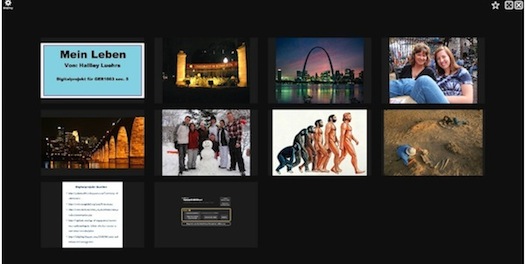
Kautz said the highlight of the semester was using a tool called VoiceThread for digital storytelling. Students received instructions on using the technology. She described the project as an autobiographical essay about their youth experiences that have shaped their current educational and career goals. The student used personal photos and voice recordings to present their stories visually.
Ginny Steinhagen, German 1004 coordinator, noted that hybrid instructors are learning the benefits of spreading out deadlines for student's feedback in forums, by allowing adequate time for students to respond to each other's posts.
Steinhagen emphasized the importance of instructor feedback for online activities in hybrid courses.
Kautz added that there is great variation in how instructor feedback occurs and how students' assignments are submitted. "There are many possibilities and we are still figuring out what works best in which situation," she said.
At the moment, developers do not have specific data on student's performance comparing German hybrid and traditional face-to-face courses. Kautz noted that there are many variables to consider and considerations in terms of how to define performance. However, Kautz said, "I anticipate that students in hybrid sections will become more fluent writers through increased writing practice in online discussion boards, but that's a research project for the future."
Screenshot from a student's digital story.
German hybrid, first offered in Fall 2012 for German 1003, is the newest of the hybrid courses currently offered at the University of Minnesota. German hybrid is unique in that it integrates new technology such as Avenue, a video recording tool, VoiceThread for digital storytelling, special Moodle tools, and Wimba Voice Board.
In the summer of 2011, Beth Kautz, a German 1003 coordinator, participated in a hybrid course in Munich about teaching hybrid language courses. "This was a transformative experience for me, which led to a year of planning before actually developing the course in the summer of 2012," Kautz said.
A small team of graduates and coordinators received a "Tools for Discovery Grant" and funding from CLA, which allowed them to create new hybrid course materials.
Kautz said German hybrid developers created their own course materials based on reading texts, podcasts, and video clips from the internet. This development allowed the German department to offer two sections of hybrid 1003 in Fall 2012, and one section of hybrid 1003 and two sections of hybrid 1004 in Spring 2013. These hybrid courses met face-to-face three days a week and online two days.
New Technology
Developers experimented with different technology, including a video-recording tool developed at the University of Minnesota, called Avenue. Classrooms also integrated Moodle tools such as discussion forums, databases, glossaries, and polls, as well as the Wimba Voice Board.
Kautz said the highlight of the semester was using a tool called VoiceThread for digital storytelling. Students received instructions on using the technology. She described the project as an autobiographical essay about their youth experiences that have shaped their current educational and career goals. The student used personal photos and voice recordings to present their stories visually.
"Students focused on presentational speaking skills to make their stories engaging and easy to understand. All the digital stories were linked in a Moodle forum, where classmates could view and comment on each other's creative work... Students were able to complete the project on their own and we were all thrilled with the results! They took great pride in their stories and the sense of community was really strengthened by sharing them with each other."
- Beth Kautz, German 1003 Coordinator
Instructor Feedback and Outcomes
Ginny Steinhagen, German 1004 coordinator, noted that hybrid instructors are learning the benefits of spreading out deadlines for student's feedback in forums, by allowing adequate time for students to respond to each other's posts.
Steinhagen emphasized the importance of instructor feedback for online activities in hybrid courses.
"In 1004, [Meagan Tripp, 1004 German instructor] has created some nice, quick Moodle quizzes that show us whether the students are understanding the reading or the grammar. As teachers, it is important for us to follow up on these quizzes (even if they are self-correcting) and comment on them in class. Integrating the hybrid day activities into face to face discussions continues to be a challenge."
- Ginny Steinhagen, German 1004 Coordinator
Kautz added that there is great variation in how instructor feedback occurs and how students' assignments are submitted. "There are many possibilities and we are still figuring out what works best in which situation," she said.
At the moment, developers do not have specific data on student's performance comparing German hybrid and traditional face-to-face courses. Kautz noted that there are many variables to consider and considerations in terms of how to define performance. However, Kautz said, "I anticipate that students in hybrid sections will become more fluent writers through increased writing practice in online discussion boards, but that's a research project for the future."
Thursday, November 29, 2012
Hybrid Language Courses Expand
Hybrid language courses, made up of both online and classroom-based instruction, are growing at the University of Minnesota. French and Spanish are piloting refined second-year hybrid courses this semester, while German is piloting its first ever hybrid class this fall in 1003.
Spanish was the first to offer hybrid courses, starting with 1022 over a decade ago. Concentrated efforts to expand hybrid course development began in 2011, when Spanish created hybrid options for 1003 and 1004 and French piloted a hybrid version of 1004.
A Hybrid Working Group was formed during the Spring 2012 semester. It includes representatives from French, German, Italian, Spanish, the Language Center, CARLA and CLA-OIT. The goals of this group are to share resources, compare experiences and learn from one another without producing identical classes for various language programs.
The group worked diligently over the summer and continues to meet this semester. Meetings typically feature at least one technical training and exploration opportunity.
The new hybrid courses address the five national standards for foreign language learning, known as the "Five C's": Communication, Cultures, Comparisons, Connections, and Communities.
I sat down with Dan Soneson, coordinator of the Hybrid Working Group and spokesperson for ComSLE, to learn more about hybrid courses and the process of the work group's collaboration.
Saoirse: How are hybrid courses adjusted/customized to suit different languages? Is there a specific model for the ideal hybrid course?
Dan: It would be great if there were one model out there that we could all adopt, but the concept of a hybrid course has developed over time and only recently have we begun to think about actually replacing class time with time online. We started the process looking at how Spanish 1022 works, and went from there.
We quickly discovered that the amount and quality of prepared online resources available to Spanish is not as readily available to the other language programs, so French, German and Italian had to find and develop more of their own materials. While Spanish had begun with the intensive elementary course, both the French and German programs decided to start at the second year. The reasoning was that by the second year students have experience with the language and might be able to work more independently in a partially online context.
Saoirse: Will hybrid courses expand to more languages and levels in the future? Are there any more languages that may be experimenting with hybrid?
Dan: That will depend on the success of these newly developed courses. The original plan was to have blended learning or hybrid courses in place for at least semesters two through four of Spanish, German, French, and possibly Italian. If we can solidify the models we develop for these languages, perhaps they can serve as templates for related language programs.
Saoirse: Do you think a hybrid model would work with upper division language courses?
Dan: I definitely think a hybrid model can work throughout the curriculum. A great deal depends on what kinds of activities can be developed to take advantage of the wealth of material and communication possibilities that technology provides.
Saoirse: What are student's reactions to these new courses? Instructor's reactions?
Dan: As you can imagine, reactions have been mixed. One thing we've learned is that students discover quickly that this course involves more work than a strict face-to-face class, even though the expected time commitment is equivalent. While it may be possible to participate less in a face-to-face class, online you need to do all the work and demonstrate your participation. This work, however, can yield greater results, since everyone is participating equally.
Instructors also note the increased workload, primarily due to reading and responding to every student's contributions to forum topics and threaded discussions. However, regular classroom participation can increase as well. One instructor stated recently that once the class gets into the rhythm of online work leading to live classroom activities, the quality of the classroom work improves, with more engaged students and more stimulating discussions.
Saoirse: What are the expectations of a hybrid course? What are the characteristics of a student who will be successful in a hybrid course?
Dan: Basically, a hybrid course represents a transformation from a conventional course that meets exclusively in a physical space (a classroom) to one in which a regular number of classroom hours take place online or through use of technology. In our case, the conventional 5-credit course meets regularly at the same hour, five days each week. The hybrid version reduces the physical in-class hours to three each week, while the other two hours take place virtually, with students engaged with similar activities or with the kind of activities that are desirable, but difficult to accomplish in a large class setting.
The expectation is that these online "classes" carry the same weight as a regular in-class meeting, and that students spend at least 50 minutes focussing on the assigned activities, at a time that is convenient for them. In addition to these online activities, students also complete regular homework assignments for each class period, whether it is virtual or face-to-face.
Successful students are well organized self-starters who can work independently and are willing to work with peers outside of the classroom. Much of the "group" work that takes place in the virtual classroom requires teamwork and an ability to contribute to a discussion in a timely manner.
Saoirse: What are some things the Hybrid Work Group achieved over the summer? What kind of technology were instructors trained on?
Dan: The Work Group met weekly over the summer to share ideas and experiences. The idea was to provide both structure and a support system for all instructors working on the process. We had people from CLA-OIT participate and share technologies in an effort to help the instructors develop activities and format the courses. We experienced the capabilities of Moodle, Kaltura, UMConnect, Google Hangouts, TurnItIn, and Avenue.
One of the major opportunities that I see for hybrid courses is the ability to pair our students with speakers of the language they are learning. Our TandemPlus program is developing connections with institutions abroad, and ideally we can connect our learners with learners of English to engage in mutually beneficial regular exchanges in which each participant has an opportunity to discuss cultural issues with a partner in the target language.
Once we have these networks firmly established, our students could spend 50 minutes online with a language partner instead of in class. The possibility of using the language in meaningful communication in 50 minutes is much greater in this situation than in a large class. There is still much work to be done to bring these internet exchanges about in a regular manner, but it would be an excellent activity taking full advantage of what internet technology has to offer. Pilot programs are already underway in French, Spanish, German and Italian.
Saoirse: Is there anything else you would like to add about hybrid language courses in general?
Dan: This hybrid development process provides a great opportunity to rethink our language programs, to take advantage of the wealth of authentic materials available on the internet and the wonderful capabilities of Computer Mediated Communication, such as threaded discussions, chat, voice chat, and teleconferencing. You mentioned the National Standards above. We have an excellent opportunity now to address all five C's through technology, exploring Cultures, Connecting to disciplinary content, drawing Comparisons through in-depth experience of cultural practices and perspectives, and providing access to a vast array of Communities that function in the target language on the Web.
This is the first in a series of articles planned on hybrid course development. Look for future blog entries concentrating on hybrid courses for Spanish, French and German.
Tuesday, August 7, 2012
TandemPlus and ESL at the St. Paul Saints Game
On Friday, July 27, TandemPlus co-hosted a night of baseball and fun with the Minnesota English Language Program. This is the first event co-hosted by these university programs and it was a great success! Both American and international students attended the Saint Paul Saints baseball game at Midway Stadium in St. Paul and spoke a variety of languages including Arabic, German, Japanese, Chinese, English and Spanish. Overall students had a great time and after 11 innings the Saints pulled through and won the game. The night ended with a spectacular fireworks show and celebration over the Saints win. We hope you will join us for our next event, and don't forget to mark your calendars -- Fall registration is less than a month away!
Monday, April 30, 2012
Branch out and Learn: The 2012 WLD Poster
This year's World Languages Day will feature sustainability-themed content courses for French, German and Spanish. The three classes are taught in the target language, and the classes are based on content recently developed for U of M language courses. See Elsie Speaks for more information on the university courses.
The World Languages Day courses are:
These classes will give high school students an opportunity to participate in a science-based content course taught in a second language.
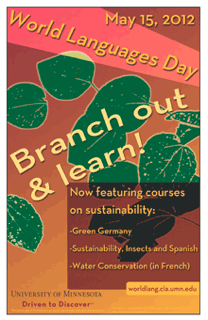
These courses are highlighted on our 2012 poster, designed by Paul Fosaaen, our Multimedia Lab Lead Student, who is graduating at the end of this semester. Congratulations Paul!
In addition to designing the WLD poster, Paul is the artist of Mi Casta Su Casta, a piece hung in the Multimedia Lab.
The World Languages Day courses are:
- French: Water Conservation and Ecology taught by Patricia Mougel
- German: Green Germany taught by Beth Kautz
- Spanish: Sustainability, Insects and Spanish taught by Frances Matos-Schultz
These classes will give high school students an opportunity to participate in a science-based content course taught in a second language.
These courses are highlighted on our 2012 poster, designed by Paul Fosaaen, our Multimedia Lab Lead Student, who is graduating at the end of this semester. Congratulations Paul!
In addition to designing the WLD poster, Paul is the artist of Mi Casta Su Casta, a piece hung in the Multimedia Lab.
Thursday, March 22, 2012
World Languages Day: Branch out and Learn!
While University of Minnesota students and faculty are counting down to various deadlines and the end of the semester, the World Languages Day planning committee continues the count-down to World Languages Day, and we can't wait! The event is scheduled for Tuesday, May 15, just two months away. We expect to draw over 1000 high school sophomores to campus.
This year, we are happy to see returning high schools from last year, from the Twin Cities metro area, as well as the northern, southern, and central areas of Minnesota. We also welcome new schools or schools that participated prior to 2011 representing a wide range of cities and town in Minnesota.
New teachers and students are in for a treat. Returnees will recognize perennial favorites on the course list, and will once again be able to learn traditional Hmong dance, greet each other in Italian, and play American Idol in German - and that's just the a small sampling of the offerings!
Reading over the course list is like flipping through a virtual travel catalogue, one that sparks cultural inquiry. Students can take Arabic Language and Culture: a Trip to Tunisia, Excursion Brazil, and A Virtual Walk through Vienna, all without leaving the U of M campus. For students who do want to leave campus, information on travel all over the world will be offered in three study abroad information sessions.
New this year will be the sounds of Afro-Cuban Music, a Spanish course which will include special musical guests. Experiencing the Chinese Language takes students on a journey through thousands of years of history. Classes such as the debut of From Atheists to Libertines: French Philosophy and the Limits of the Imagination challenge our assumptions in learning about other cultures and places, and the people we meet along the way.
There is also a cross-curriculum focus on sustainability offered this year: Water Conservation and Ecology (French), Sustainability, Insects, and Spanish, as well as Green Germany, each taught in the target language. Students will have the chance to apply their knowledge of science and the economy to their language studies in these different cultural contexts.
Take a look at our online course list for both new and proven ways to stretch imagination, broaden cultural knowledge, and express yourself in 23 different languages offered at World Languages Day this May.
In the meantime, the planning continues! Look out for more information on registration coming soon. You can view the class list, and learn more about the event at our website.
This year, we are happy to see returning high schools from last year, from the Twin Cities metro area, as well as the northern, southern, and central areas of Minnesota. We also welcome new schools or schools that participated prior to 2011 representing a wide range of cities and town in Minnesota.
New teachers and students are in for a treat. Returnees will recognize perennial favorites on the course list, and will once again be able to learn traditional Hmong dance, greet each other in Italian, and play American Idol in German - and that's just the a small sampling of the offerings!
Reading over the course list is like flipping through a virtual travel catalogue, one that sparks cultural inquiry. Students can take Arabic Language and Culture: a Trip to Tunisia, Excursion Brazil, and A Virtual Walk through Vienna, all without leaving the U of M campus. For students who do want to leave campus, information on travel all over the world will be offered in three study abroad information sessions.
New this year will be the sounds of Afro-Cuban Music, a Spanish course which will include special musical guests. Experiencing the Chinese Language takes students on a journey through thousands of years of history. Classes such as the debut of From Atheists to Libertines: French Philosophy and the Limits of the Imagination challenge our assumptions in learning about other cultures and places, and the people we meet along the way.
There is also a cross-curriculum focus on sustainability offered this year: Water Conservation and Ecology (French), Sustainability, Insects, and Spanish, as well as Green Germany, each taught in the target language. Students will have the chance to apply their knowledge of science and the economy to their language studies in these different cultural contexts.
Take a look at our online course list for both new and proven ways to stretch imagination, broaden cultural knowledge, and express yourself in 23 different languages offered at World Languages Day this May.
In the meantime, the planning continues! Look out for more information on registration coming soon. You can view the class list, and learn more about the event at our website.
Monday, November 21, 2011
Green German Project Takes Off
The collaborators of the Green German Project have been busy this fall actively promoting the new course materials they developed for teaching topics related to sustainability.The website, from which teachers and curriculum developers can download the PDF learning modules, went live last week and can be found at http://z.umn.edu/greengerman. Included on the site are a bibliography, links to over 230 websites with authentic materials, a chart aligning each exercise with the National Standards, and a longer description of the project.
On Nov. 20, 2011, Charlotte Melin and Beth Kautz introduced the materials to an enthusiastic audience at the national AATG/ACTFL conference in Denver. Last month, Adam Oberlin and Beth Kautz introduced the materials to a local audience at the MCTLC conference, where their presentation was voted "Best of Minnesota." They have been invited to share their presentation at the March 2013 Central States Conference in Columbus, OH.
For information about other U of M projects linking sustainability issues and foreign languages and cultures, see this earlier blog post.
On Nov. 20, 2011, Charlotte Melin and Beth Kautz introduced the materials to an enthusiastic audience at the national AATG/ACTFL conference in Denver. Last month, Adam Oberlin and Beth Kautz introduced the materials to a local audience at the MCTLC conference, where their presentation was voted "Best of Minnesota." They have been invited to share their presentation at the March 2013 Central States Conference in Columbus, OH.
For information about other U of M projects linking sustainability issues and foreign languages and cultures, see this earlier blog post.
Friday, November 4, 2011
Sustainability and Language Acquisition: Different Approaches to Integrating Academic Content for Different Languages
When the French, German and Spanish language programs had the opportunity to collaborate on the creation of sustainability-themed content for their courses, they jumped right in. However, curriculum developers from the three programs had a different visions for how the content would ultimately be integrated into their university languages courses.
This spring semester, University of Minnesota language students will have several new opportunities to learn about sustainability at the same time as they continue second language acquisition.
Part of the curriculum development was funded by Title VI to create Foreign Languages Across the Curriculum Content (FLAC) resources for K-12 and university courses. The team working to get these initiatives off the ground is:
Elaine Tarone (CARLA)
Patricia Mougel (French)
Charlotte Melin and Beth Kautz (German)
Susan Villar and Frances Matos-Schultz (Spanish).
Here is an overview of the two approaches the programs took for integrating academic content with second language acquisition, focusing on examples of classes offered Spring 2012:
French and German: Upper-level course enhancement and redesign
FREN 3022 The Language and Culture of Business in France
GER 3501 Contemporary Germany: Environmental Debates--Food, Energy, Politics
Patricia is currently teaching her French advanced oral communication class as a new content-based language course on the theme of water. For Spring 2012, Patricia is revamping her ongoing business course, integrating new content on sustainability while keeping the focus on business overall. In the course students will learn about and discuss sustainable business practices in France through case studies of businesses that have moved towards sustainability in terms of resources selection, product development, marketing and human resources management.
During Spring 2011, Charlotte taught a German course with an environmental literature theme. For Spring 2012, she has completely redeveloped an existing course on contemporary Germany. Students will be able to use this course towards the completion of the Sustainability Minor by petition. Here is the course description:
Public concern about environmental issues is driving social, political, and cultural change in German-speaking countries today--a trend visible in the successes of the Green party in recent elections and plans to decommission nuclear power plants over the next decade. This course (taught in German) looks at the ways environmental imagination is expressed through language and contemporary culture. We will examine the evolution of the environmental movement and European conceptions of sustainability through the lens of nonfiction writings, literature, on-line resources, and film. Historically, concepts of ecology arose out of early 20th century discoveries about interconnectedness, epitomized by the term Umwelt (surrounding world), which was coined by Jakob von Uexküll. In keeping with this systems perspective, we will study examples like food production, energy consumption, and urban design. To take into account the divergent opinions that surround these topics, assignments will include debates, expository writing, and creative projects that probe differing positions.
Spanish: Integration throughout the lower-level curriculum
SPAN 1022, 1003, 1004 Second-Semester and Intermediate Spanish
Spanish has begun integrating sustainability content modules into all of their hybrid Spanish 1022 and 1003 sections. The program also plans to integrate the content into hybrid Spanish 1004, once that class debuts. This means that as more Spanish sections switch to the hybrid format, as many as 900 to 1000 students will interact with sustainability content each semester.
Interested in learning more? If you are an advanced student of French or German, or a beginning student of Spanish, take a class Spring semester! Registration for FREN 3022 is open for students of French who have completed 3015 (3016 is recommended). GER 3501 is open for German students who have completed 3011W. All sections of SPAN 1022 are hybrid, as well as some sections of 1003. Contact the appropriate department for more information on these courses.
You can also read more about the development of the German class, and how some of the content debuted at World Languages Day at Elsie Speaks, and Charlotte wrote an article about her Spring 2011 class for Neues Curriculum.
This spring semester, University of Minnesota language students will have several new opportunities to learn about sustainability at the same time as they continue second language acquisition.
Part of the curriculum development was funded by Title VI to create Foreign Languages Across the Curriculum Content (FLAC) resources for K-12 and university courses. The team working to get these initiatives off the ground is:
Elaine Tarone (CARLA)
Patricia Mougel (French)
Charlotte Melin and Beth Kautz (German)
Susan Villar and Frances Matos-Schultz (Spanish).
Here is an overview of the two approaches the programs took for integrating academic content with second language acquisition, focusing on examples of classes offered Spring 2012:
French and German: Upper-level course enhancement and redesign
FREN 3022 The Language and Culture of Business in France
GER 3501 Contemporary Germany: Environmental Debates--Food, Energy, Politics
Patricia is currently teaching her French advanced oral communication class as a new content-based language course on the theme of water. For Spring 2012, Patricia is revamping her ongoing business course, integrating new content on sustainability while keeping the focus on business overall. In the course students will learn about and discuss sustainable business practices in France through case studies of businesses that have moved towards sustainability in terms of resources selection, product development, marketing and human resources management.
During Spring 2011, Charlotte taught a German course with an environmental literature theme. For Spring 2012, she has completely redeveloped an existing course on contemporary Germany. Students will be able to use this course towards the completion of the Sustainability Minor by petition. Here is the course description:
Public concern about environmental issues is driving social, political, and cultural change in German-speaking countries today--a trend visible in the successes of the Green party in recent elections and plans to decommission nuclear power plants over the next decade. This course (taught in German) looks at the ways environmental imagination is expressed through language and contemporary culture. We will examine the evolution of the environmental movement and European conceptions of sustainability through the lens of nonfiction writings, literature, on-line resources, and film. Historically, concepts of ecology arose out of early 20th century discoveries about interconnectedness, epitomized by the term Umwelt (surrounding world), which was coined by Jakob von Uexküll. In keeping with this systems perspective, we will study examples like food production, energy consumption, and urban design. To take into account the divergent opinions that surround these topics, assignments will include debates, expository writing, and creative projects that probe differing positions.
Spanish: Integration throughout the lower-level curriculum
SPAN 1022, 1003, 1004 Second-Semester and Intermediate Spanish
Spanish has begun integrating sustainability content modules into all of their hybrid Spanish 1022 and 1003 sections. The program also plans to integrate the content into hybrid Spanish 1004, once that class debuts. This means that as more Spanish sections switch to the hybrid format, as many as 900 to 1000 students will interact with sustainability content each semester.
Interested in learning more? If you are an advanced student of French or German, or a beginning student of Spanish, take a class Spring semester! Registration for FREN 3022 is open for students of French who have completed 3015 (3016 is recommended). GER 3501 is open for German students who have completed 3011W. All sections of SPAN 1022 are hybrid, as well as some sections of 1003. Contact the appropriate department for more information on these courses.
You can also read more about the development of the German class, and how some of the content debuted at World Languages Day at Elsie Speaks, and Charlotte wrote an article about her Spring 2011 class for Neues Curriculum.
Subscribe to:
Posts (Atom)