Go to the U of M home page
Showing posts with label LPE. Show all posts

Tuesday, January 14, 2014

New and Improved Language Assessments: Spanish SOPI, ILA, Self-Assessments and More!

Until recently, the Language Proficiency Exam (LPE) was the only central tool available for language students to evaluate their language skills at the intermediate level, and there were no options for students who had surpassed that level. Today though, the Language Testing Program is working with language program developers to diversify the tools available to students, and to reach students whose language is not taught at the University, and those who have achieved higher levels of proficiency.

The LPE remains the most important tool available. In addition to tests already in place for Arabic, Chinese, Hmong, Italian, Japanese, Russian, and a second version of the Spanish LPE Reading and Listening sections, other new assessments are in progress. Development is underway for Finnish, Korean, Somali, and Swahili LPE's this semester. A new form of the German Reading LPE will be piloted in November.

Beyond the LPE, the following new assessments have been piloted, will be piloted or are now actively administered to students: the Spanish Simulated Oral Proficiency Interview (SOPI), the Individual Language Assessment (ILA) and several Self-Assessment instruments.

The Spanish SOPI


A SOPI is a computerized version of an Oral Proficiency Interview (OPI) administered in a Digital Language Lab (DiLL) to a class of students simultaneously. The primary advantage of a SOPI over a traditional OPI is that the time required to administer the test is significantly reduced. It would take at least six hours to administer OPIs to a class of 24 students; with a SOPI, this can be done in less than one class period. Of course, all of those exams still need to be rated!

"In delivering an interview via computer, the SOPI may shift the center of power more toward the students; they may feel more ownership of their half of the (simulated) interaction, and thus feel more confident about speaking."  

-Gabriela Sweet, assessment developer and lead trainer

Students are provided with a real-life context to speak in Spanish, recording their responses in the lab using DiLL. Student feedback was generally positive after the February pre-pilot. Students commented that the SOPI is more efficient and less stressful and that they enjoyed using the SOPI in lieu of the traditional face-to-face format.

The SOPI's delivery, in capturing extended student speech, reduces the possibility of a difficult-to-rate interview, which can occur in face-to-face interviews when learners may not get the opportunities they need to demonstrate the full range of their language abilities. Developers hope to use the SOPI assessment with College in the Schools (CiS) students in the future, and it is possible to adapt this assessment for other languages as the prompts are in English.

As with the OPI, SOPI tasks are designed to target a wide range of linguistic functions and real-world topics at the student's target level of proficiency. The SOPI is also more standardized compared to the OPI because it systematically facilitates a ratable sample of student speech. Students naturally tend to speak in complete sentences in the SOPI, which may not happen during the live interview when they can appropriately respond in sentence fragments. Since the SOPI response is at sentence-level, it may be easier for raters to analyze.

A six-person team carried out the SOPI pilot. This team included Spanish 1004 coordinator Sara Mack, Spanish 1004 instructors Marilena Mattos and Stephanie Hernández, Spanish Testing Coordinator Joanne Peltonen, Language Center Testing Development Coordinator Gabriela Sweet and Language Center Technical Coordinator Diane Rackowski. Additional input and support was provided by Language Center Director Dan Soneson.

The ILA


Did you know the Testing Program now provides assessment in languages from Amharic to Zulu?

CLA students who have achieved proficiency in a language not offered at the University of Minnesota have a new way to demonstrate their proficiency and complete the second language requirement. The ILA is a writing and speaking test that is adaptable for any modern language. It tests to the intermediate level, which is the level expected after two years of university language study. The test is rated by native or near-native speakers of the particular language who are trained and guided by Language Testing Program staff.

Since January 2013, a total of 32 students have been approved to take ILAs in 16 languages from around the world, including major languages spoken by hundreds of millions of people worldwide, but rare on our campus, and dialects specific to a particular village. The most common languages assessed are Vietnamese and Oromo.

For many languages, it can be challenging to find a qualified rater. Most raters are affiliated with the University as faculty, staff, graduate students, or former students. They are almost always native speakers with some prior linguistic or educational experience. Some of the raters have few other opportunities to use their language skills professionally, although they may use the language in their daily life.

Stephanie Treat, who has assisted with the hiring of most raters, said:

"We often get requests to rate languages that I've never heard of or know little about. We've had fun researching languages and scouring campus and beyond to find potential raters. The University of Minnesota is a global community, and with persistence, we can usually find someone currently connected to campus who is pleased to share his or her expertise."

In order to conform to the CLA mandate for proficiency in a second language, ILA raters are trained using guidelines that align with those used to evaluate student performance in languages that are taught at the University of Minnesota and that have an LPE. Before ILA raters begin the evaluation process, they are made familiar with both the instrument and the target level for production. The rater-training process is very hands-on; criteria are analyzed and then applied. The rater works closely with the rater trainer. Raters are guided through the process using a rater-training module.


The Language Testing Program plans to create a video to facilitate rater training, as well as refresher training, for raters who have completed evaluations at an earlier date but would need a quick refamiliarization to ensure that they apply the criteria in the same way to a new student's ILA. "We've been fortunate to work with some very talented people," assessment developer and lead trainer Gabriela Sweet said.

"It's fascinating to work with someone on a language with which you, the trainer, have very little experience, to see them point out clearly how students demonstrate the target levels. It has been a wonderful experience for us, in the Testing Program, to see how students in a variety of languages are able to show their proficiency in alignment with the College of Liberal Arts student learning objectives. I think it's also a privilege to be able to learn from colleagues in diverse languages; in hearing what students say and reading what they write in the ILAs we begin to see that the world is, in some ways, quite small... we're all working toward many of the same goals."  

- Gabriela Sweet

Students interested in completing the CLA second language requirement via ILA exam should begin by contacting their advisor. CLA Student Services approves requests first, and then students contact the Language Testing Program to schedule an exam. There is a $30.00 fee assessed to assist with the cost of rater compensation. Students who pass both sections of the exam complete the CLA second language requirement.

Self-Assessment Instruments


Self-Assessment instruments help students become more aware of their own language development and describe their level of proficiency. This type of instrument requires little time to administer and students can take it from home at their convenience. Students can take the same assessment more than once and track their language development over time.

Two Self-Assessments for Spanish are currently in development: one intended for Spanish 1004 students and another which assesses higher-level proficiency for students pursuing the Certificate of Advanced-Level Proficiency. Developers are also creating new self-assessments for German, Italian, and French.

Students can use these self-assessments for feedback on performance in a language and to better prepare themselves before taking the LPE or other exam. In a pilot study in Fall 2013, many students found the self-assessments helpful and noted that routine self-assessment would be helpful in the future. The test developers will be very pleased to share more information about these instruments once they have been piloted and results have been analyzed.

SOPI, ILA, Self-Assessments


Developers in the Language Testing Program and the academic departments have been hard at work developing and improving language assessment instruments to create a more personalized, modern, and enjoyable testing experience for students. Undergraduate students themselves have played an important role by piloting these assessments and providing valuable feedback to developers. These new tests are designed to accurately reflect students' abilities and to provide them with information they can use as they continue to develop their proficiency.


Type of AssessmentBenefits / ImprovementsDevelopment Timeframe
New Language Proficiency Exams (LPE's)Korean and Somali were added as new LPE exam options. Adding these languages provides students with more possibilities in assessing language proficiency.Korean: Will pilot Reading in Spring. Listening & Writing are ready to go!

Somali: Will pilot Reading, Listening, and likely Writing this Spring
New German Reading TestDeveloped another form in addition to Form A. Form B is up-to-date; the readings from Form A were 20 years old. Better quality photos were also added.The Reading test will be piloted this Fall semester
Simulated Oral Proficiency Interview (SOPI)Spanish 1004: Extended time limit for thinking and speaking. Bigger, better resolution photos.Piloted in Spring 2013
Individualized Language Assessment (ILA)One format for all languages as a test of Speaking and Writing. Allows students flexibility in composing responses about real-world situations.The test has been administered to 16 students with many more expected in the future. The long-term goal is to develop multiple versions of the test.
Self-Assessment InstrumentsSpanish 1004: Students can demonstrate their second language proficiency before taking final proficiency tests

Spanish Advanced Level: To help students determine their proficiency level. Intended for students pursuing the Certificate of Advanced-Level Proficiency.
Spanish 1004: Pilot was completed in Fall 2013

Spanish Advanced Level: Piloted with Spanish students December 11, 2013

German: Pilot 5 sections in Spring 2014

Italian: Pilot in two section Spring 2014

French: Pilot in eight sections Spring 2014


Monday, September 16, 2013

The Language Testing Program Welcomes Anna Olivero-Agney

Please welcome Anna Olivero-Agney to the Testing development team. Anna has been an Italian instructor at the French and Italian Department for the past seven years teaching Italian at beginning, intermediate and upper levels. She holds a Laurea in Modern Foreign Languages from the University of Turin, Italy and a MA in Education, Curriculum and Instruction from the University of Minnesota. She is a native of Italy and prior to her move to the US, Anna lived in Germany for four years refining her skills in the German language.

In addition to teaching, Anna co-created the Italian LPE reading section and revised the listening section of the Italian Language Proficiency Exam (LPE) gaining familiarity with test item development. In her new position, she will be assisting Gabriela Sweet in the completion of the German LPE revisions, the piloting of Somali and Korean LPE, and the Self-Assessment project.

Monday, December 10, 2012

Spanish 1004 LPE: Reading, Listening and Writing Now Completely Online

The Language Proficiency Exam (LPE) is integrated into the fourth-semester courses of many languages. Students in fourth-semester Spanish take the reading, listening and writing portions of the LPE during regular class periods, and beginning Fall 2012, they are the first language classes to take the three parts of the LPE online. Until now, the LPE reading and listening have been taken online as the final exam. However, the LPE writing test was still on paper in the students' classroom. The writing section is rated by instructors, whereas the the reading and listening sections are computer-graded.

Last week all students in Spanish 1004, 1014, and 1044 came to Jones Hall during a regular class period to take the LPE writing test online in one of the computer labs. This change is possible due to upgrades to the online LPE delivery system that allow students' exams to be linked to a specific course section. This means for example, that all exams taken by Spanish 1004-006 students can be linked for grading purposes. When the new system is fully implemented, instructors will be able pull up student exams by section through the grader interface and evaluate the individual tests.

Thursday, November 29, 2012

Hybrid Language Courses Expand

hybrid word_cloud

Hybrid language courses, made up of both online and classroom-based instruction, are growing at the University of Minnesota. French and Spanish are piloting refined second-year hybrid courses this semester, while German is piloting its first ever hybrid class this fall in 1003.

Spanish was the first to offer hybrid courses, starting with 1022 over a decade ago. Concentrated efforts to expand hybrid course development began in 2011, when Spanish created hybrid options for 1003 and 1004 and French piloted a hybrid version of 1004.

A Hybrid Working Group was formed during the Spring 2012 semester. It includes representatives from French, German, Italian, Spanish, the Language Center, CARLA and CLA-OIT. The goals of this group are to share resources, compare experiences and learn from one another without producing identical classes for various language programs.

The group worked diligently over the summer and continues to meet this semester. Meetings typically feature at least one technical training and exploration opportunity.

The new hybrid courses address the five national standards for foreign language learning, known as the "Five C's": Communication, Cultures, Comparisons, Connections, and Communities.

I sat down with Dan Soneson, coordinator of the Hybrid Working Group and spokesperson for ComSLE, to learn more about hybrid courses and the process of the work group's collaboration.


Saoirse: How are hybrid courses adjusted/customized to suit different languages? Is there a specific model for the ideal hybrid course?

Dan: It would be great if there were one model out there that we could all adopt, but the concept of a hybrid course has developed over time and only recently have we begun to think about actually replacing class time with time online. We started the process looking at how Spanish 1022 works, and went from there.

We quickly discovered that the amount and quality of prepared online resources available to Spanish is not as readily available to the other language programs, so French, German and Italian had to find and develop more of their own materials. While Spanish had begun with the intensive elementary course, both the French and German programs decided to start at the second year. The reasoning was that by the second year students have experience with the language and might be able to work more independently in a partially online context.

Saoirse: Will hybrid courses expand to more languages and levels in the future? Are there any more languages that may be experimenting with hybrid?

Dan: That will depend on the success of these newly developed courses. The original plan was to have blended learning or hybrid courses in place for at least semesters two through four of Spanish, German, French, and possibly Italian. If we can solidify the models we develop for these languages, perhaps they can serve as templates for related language programs.

Saoirse: Do you think a hybrid model would work with upper division language courses?

Dan: I definitely think a hybrid model can work throughout the curriculum. A great deal depends on what kinds of activities can be developed to take advantage of the wealth of material and communication possibilities that technology provides.

Saoirse: What are student's reactions to these new courses? Instructor's reactions?

Dan: As you can imagine, reactions have been mixed. One thing we've learned is that students discover quickly that this course involves more work than a strict face-to-face class, even though the expected time commitment is equivalent. While it may be possible to participate less in a face-to-face class, online you need to do all the work and demonstrate your participation. This work, however, can yield greater results, since everyone is participating equally.

Instructors also note the increased workload, primarily due to reading and responding to every student's contributions to forum topics and threaded discussions. However, regular classroom participation can increase as well. One instructor stated recently that once the class gets into the rhythm of online work leading to live classroom activities, the quality of the classroom work improves, with more engaged students and more stimulating discussions.

Saoirse: What are the expectations of a hybrid course? What are the characteristics of a student who will be successful in a hybrid course?

Dan: Basically, a hybrid course represents a transformation from a conventional course that meets exclusively in a physical space (a classroom) to one in which a regular number of classroom hours take place online or through use of technology. In our case, the conventional 5-credit course meets regularly at the same hour, five days each week. The hybrid version reduces the physical in-class hours to three each week, while the other two hours take place virtually, with students engaged with similar activities or with the kind of activities that are desirable, but difficult to accomplish in a large class setting.

The expectation is that these online "classes" carry the same weight as a regular in-class meeting, and that students spend at least 50 minutes focussing on the assigned activities, at a time that is convenient for them. In addition to these online activities, students also complete regular homework assignments for each class period, whether it is virtual or face-to-face.

Successful students are well organized self-starters who can work independently and are willing to work with peers outside of the classroom. Much of the "group" work that takes place in the virtual classroom requires teamwork and an ability to contribute to a discussion in a timely manner.

Saoirse: What are some things the Hybrid Work Group achieved over the summer? What kind of technology were instructors trained on?

Dan: The Work Group met weekly over the summer to share ideas and experiences. The idea was to provide both structure and a support system for all instructors working on the process. We had people from CLA-OIT participate and share technologies in an effort to help the instructors develop activities and format the courses. We experienced the capabilities of Moodle, Kaltura, UMConnect, Google Hangouts, TurnItIn, and Avenue.

One of the major opportunities that I see for hybrid courses is the ability to pair our students with speakers of the language they are learning. Our TandemPlus program is developing connections with institutions abroad, and ideally we can connect our learners with learners of English to engage in mutually beneficial regular exchanges in which each participant has an opportunity to discuss cultural issues with a partner in the target language.

Once we have these networks firmly established, our students could spend 50 minutes online with a language partner instead of in class. The possibility of using the language in meaningful communication in 50 minutes is much greater in this situation than in a large class. There is still much work to be done to bring these internet exchanges about in a regular manner, but it would be an excellent activity taking full advantage of what internet technology has to offer. Pilot programs are already underway in French, Spanish, German and Italian.

Saoirse: Is there anything else you would like to add about hybrid language courses in general?

Dan: This hybrid development process provides a great opportunity to rethink our language programs, to take advantage of the wealth of authentic materials available on the internet and the wonderful capabilities of Computer Mediated Communication, such as threaded discussions, chat, voice chat, and teleconferencing. You mentioned the National Standards above. We have an excellent opportunity now to address all five C's through technology, exploring Cultures, Connecting to disciplinary content, drawing Comparisons through in-depth experience of cultural practices and perspectives, and providing access to a vast array of Communities that function in the target language on the Web.

This is the first in a series of articles planned on hybrid course development. Look for future blog entries concentrating on hybrid courses for Spanish, French and German.


Thursday, October 25, 2012

The LPE Changes with the Times

The Language Testing Program now offers computerized Language Proficiency Exams (LPEs) in more languages than ever before. Tests currently in development feature culturally-rich authentic source material such as clips from modern Korean film, a look at the Somali-speaking community in the Twin Cities, and much more!

scene from Korean film
Example of culturally authentic material that could be used in LPE
Computerized LPEs were established in 2001. Hundreds of language students take them each semester to fulfill the College of Liberal Arts (CLA) language requirement and as a gateway to advanced language study. The mission of the Language Testing Program has remained constant: to accurately assess students' ability to listen, read, write and speak in the target language.
However, the program has changed and grown since 2001. The LPE is constantly being improved and the pace of modernization and innovation has picked up in the last few years. The Language Testing Program has focused on two new goals since 2010:  to serve as many language students as possible and to improve the students' exam experience by including contemporary and diverse media from the target language culture.

Before 2010, a computerized test was available only for students of French, German and Spanish and a few related languages. Students of Asian and other less commonly taught languages were limited to paper-based tests, or had no exam options at all.

Tests are now in place for Arabic, Chinese, Hmong, Italian, Japanese and Russian, and there is a second version of the Spanish LPE. In addition, development is underway for Finnish, Korean, Somali, and Swahili. All of these tests were made possible through an influx of funding from Title VI and other sources, along with a committed effort on the part of the Language Testing Program and the individual language programs to work together tirelessly and collaboratively. Once all of the newer exams are completed, the LPE will be available for almost all non-Classical languages offered in CLA and will reflect the diversity of languages available at the University of Minnesota.

As new tests are created, the Language Testing Program and the developers aim to bring new depth to the student experience and to conform more closely to current trends in second language pedagogy with increased emphasis on culturally-rich contexts. The new exams retain the original LPE goal of validating the work of students in their four semesters at the university by providing an opportunity to show what they can do with the target language in a communicative context.

However, they are not just tests - they are also learning opportunities for students, highlighting something new about the culture, history, or people of the target language through the use of authentic materials. Students may learn, for example, how traditional holiday celebrations have changed over time as societies become increasingly multicultural. There are also explorations of how gender roles have shifted and how these shifts impact language as well as cultural practice. One exam features an innovative, and perhaps surprising, environmental initiative. Another explores the lyrics of a popular song from a YouTube video.

The piloting process for new LPEs often includes a survey of student opinions about the test. Reactions to the new authentic content have been overwhelmingly positive. Test-takers have said that they were surprised and pleased to see that they had no difficulty reading texts that they might encounter on a daily basis in the target culture.

Here are some sample student reactions:

It made me realize the potential of a real-life usage for the language I've been studying.

I liked that the readings were all things I'd have to figure out in real life. It was a very pleasant experience to read articles from Japan.


The Korean LPE also offers a significant technological innovation: the incorporation of authentic video segments into the listening section. The test includes five diverse clips from modern Korean film showing natural and interesting interactions between native speakers. The use of authentic video is an excellent platform from which to assess listening proficiency, since it ties closely to the construct of listening in a communicative context, where meaning is negotiated based on a variety of input sources. The Korean listening exam has already been piloted once, and the response to the test was enthusiastically positive. Students reported that they especially enjoyed the video segments and felt confident that they could understand content overall, even though there may have been a few words unfamiliar to them.

The Somali listening section will include some authentic video segments as well. This exam stands out because it is set locally and explores the lives of immigrants integrating with the larger community as they share their language and culture - a reflection of the changing face of the Twin Cities.

Since 2010, new LPE creation has been led by Gabriela Sweet, who has worked tirelessly to organize a rotating team of developers, coordinate with multiple departments and stakeholders, and keep all projects on time and moving forward. The Korean, Somali, and Swahili development teams also include Language Center AV Developer Alaina Witt, Item Reviewers Xinyi Wu and Meghan McFadden, and LC Technical Coordinator Diane Rackowski.

The current language-specific developers are:

Finnish: Dan Karvonen, Jaana Viljakainen

Korean: Hangtae Cho, Yunseong Cheong

Somali: Said Ahmed, Abdulkarim Maalin

Swahili: Angaluki Muaka


Much of the funding for Korean development has been provided by a CLA InfoTech Tools for Discovery Grant. Title VI funding managed by the Institute for Global Studies has provided some travel and development grants for Somali and Swahili.

The Language Testing Program and the Department of Asian Languages and Literatures plan to present the new Korean listening section featuring authentic video later this winter. The U of M language community will have an opportunity to see how the classic LPE format can be modernized with technology to provide students with an educational, culturally-rich, and even enjoyable testing experience.


Tuesday, January 17, 2012

Congratulations to the Language Testing Team!

The Language Testing Program team of Monica Frahm, Mary Norman, Joanne Peltonen, Gabriela Sweet and Sondes Wooldridge has won a 2012 CLA Outstanding Service Award. The work group was recognized for supporting the testing needs of over 7200 students each year, as well as for its role in the development of new computerized Language Proficiency Exams (LPEs) for critical and high-enrollment languages.

Thanks to the Testing Program staff, the full LPE development team, and the support of language instructors and departments, CLA students of Arabic, Chinese, Italian, Japanese, and Russian now have access to the same computerized proficiency exams as students of French, German and Spanish. In addition, there is a second version of the Spanish test available, and development is underway for computerized tests in Hmong, Finnish and Korean.

You can read more about the new LPEs at Elsie Speaks. The Outstanding Service Awards will be presented at the CLA Staff Appreciation Ceremony on January 24.

Tuesday, September 13, 2011

CLA Language Center Open House

Tuesday, September 27LC Multimedia Lab
1:30 - 3:00 p.m.
Jones 110


SPY on your students' on-line, in-class work!
GATHER up to 30 students in one high-tech classroom!
SPRAWL OUT on our brand-new comfy lounge furniture!

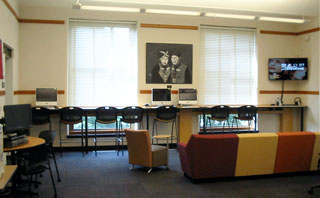
Come see the newly renovated walk-in Multimedia Lab and digital language labs, and learn more about Language Center services and facilities. Beverages and desserts will be served. Optional tech training and tours will be available.

While you enjoy coffee, cider and cookies, learn more about the following:
  • Our completely renovated walk-in Multimedia Lab, Jones 135
  • Our renovated classrooms, Jones 10 and 30
  • New LPEs for critical and popular less commonly taught languages
  • And more!


Sunday, September 11, 2011

New Computerized LPEs for Critical and High-Enrollment Languages

This year, hundreds of students of critical and popular less commonly taught languages will have access to the same computerized proficiency exams as students of French, German and Spanish. Exams for the following languages have recently been developed: Arabic, Chinese, Italian, Japanese, Russian, and a second version of Spanish.

In late summer 2010, Monica Frahm, Testing Director, received an initial Title VI grant from the Institute for Global Studies (IGS) to begin development of new computerized Language Proficiency Exams (LPEs) for critical and high-enrollment languages. Prior to this major development project, computerized tests were only available to students of Danish, Dutch, French, German, Norwegian, Spanish, and Swedish. Since summer 2010, additional Title VI grant funding has been received, as well as funding from other sources, to continue development in multiple languages.

The LPE is one method that students can use to complete their second language requirement, and this test has several other purposes as well. It can be used to place students into upper division courses, and some language programs integrate the test into their curriculum and use it as their class final exam. Students who pass the LPE receive a text line on their transcript endorsing their language proficiency, and they can receive other documentation of language proficiency upon request.

There are four sections of the LPE: Reading, Writing, Listening, and Speaking. The LPE Development Team has created tests for the first three sections. The Speaking section for all languages is generally administered as a one-on-one Oral Proficiency Interview (OPI), and it was not revised through this project. In most cases, development of the Writing and Listening sections went faster, and they were ready for piloting first. The Reading was generally completed last, as it is the most time-intensive section to develop.

In the past, LPEs were developed over the course of years and were often the product of a single, deeply committed instructor. The current project was different, because it formed a development team of instructors working on multiple languages simultaneously, under the direction of a single coordinator. The team, called the LPE Development Team, was able to collaborate and share resources. They also worked on a similar development schedule and with the same level of technical assistance and resources. This process allowed development to progress very quickly, while maintaining a high level of supervision and quality control.

Development has not always been easy, and with different schedules and the requirements of different funding sources, few developers have been able to stay with the project from start to end. However, the contributions of developers from different backgrounds, and with different skill sets, may have resulted in better tests for students.

All of the LPEs feature authentic materials, such as culturally-appropriate readings and audio recorded by native speakers, often in multiple dialects. The tests target the appropriate language level, and the test items cover a range of tasks, topics, and linguistic functions. The teams created the tests using a common test blueprint and are consistent with the programming used by other LPEs.

In addition to tests developed for languages listed above, the paper-based Hmong LPE has been incorporated into a computerized format for two modalities, and the third is under development this semester. There is also a new Finnish LPE in progress.

The LPE Development Team has been led by Coordinator Gabriela Sweet, who for over a year has corralled a rotating team of developers and juggled multiple languages, cultures, schedules, and deadlines. In addition to managing the development team and keeping the entire project on target, she has conducted stakeholder sessions with departments, taken advantage of any opportunity for piloting, managed to be friendly and cheerful, and amazingly enough, consistently greeted everyone in their native language.

The other core team member has been Lindsey Lahr, AV Tech, who has recorded and edited the listening sections, as well as completed all the multimedia work. Lindsey has been invaluable to the project in providing additional reviews and keeping teams on track and on schedule. Her creativity has given the new Reading exams, in particular, a very professional look.

Diane Rackowski, Technical Coordinator, has made an important contribution to the team's work by providing data after each piloting session, sometimes as quickly as twenty minutes after the session finished! Having these data enabled developers to analyze the performance of individual items and the test as a whole, and to then make informed decisions toward revision.

This project has been possible because of a large team of developers and instructors willing to review tests and contribute to piloting. A full list of developers is included at the bottom of this article.

As part of the piloting process, the team has surveyed students on their reactions to the tests. Students have reported that they enjoy taking the tests on the computer. From a survey after one of the new Reading tests: "I really like the way this test was set up and, in general, I feel the vocabulary was that which we had exposure to." And another comment: "I like the variety: some of the readings are articles, and some are actual pieces of literature."

Language instructors will have an opportunity to learn more about the the new tests at the upcoming Language Center Fall Open House, scheduled for Tuesday, September 27 at 1:30 PM.

LPE Development Team

Core Team:Gabriela Sweet, Coordinator
Monica Frahm, Principle Investigator
Lindsey Lahr, AV Tech
Diane Rackowski, Technical Assistance

Language Developers:
Arabic: Hisham Khalek, Sondes Wooldridge
Chinese: Ka Po Chow, Hao Ji, Liu Ya, Quan Jiahong, Andie Fang Wang, Zhen Zou
Finnish: Dan Karvonen, Jaana Viljakainen
Hmong: Maxwell LeYang
Italian: Cristina Cocchi, Anna Olivero-Agney
Japanese: Hiroe Akimoto, Michiko Buchanan, Sachiko Horii, Liu Ya
Russian: Sachiko Horii, Kateryna Kent, Marina Posse, Maria Schweikert
Spanish: Adriana Gordillo, Joanne Peltonen, Gabriela Sweet, Naomi Wood
Cross-language validation team: Kateryna Kent, Xinyi Wu, Xi Yu

Special Thanks to:
Instructors from the Department of Asian Languages and Literatures; Department of German, Scandinavian, and Dutch; Department of French and Italian; Department of Slavic Languages and Literatures; Department of Spanish and Portuguese