
Showing posts with label Professional Development. Show all posts
Showing posts with label Professional Development. Show all posts
Monday, July 10, 2017
Get involved! Join the the Professional Development (PD) Peer Team
New to foreign language teaching? Looking for ways to get involved in professional development opportunities? Interested in building up your CV? Please consider joining the PD Peer Team, a group formed of language instructors from all language programs in CLA. The group is charged with advising the Language Center on professional development opportunities. As a group, we discuss topics of interest to language instructors, share our current instructional challenges, and strive to advance the profession. Our group meets once monthly for an hour session. Please contact Adolfo Carrillo Cabello at carri093@umn.edu to get connected.
Monday, August 15, 2016
LATIS and Language Center Drop-in TechHub
Friday, September 2, 2016
10:30-3:00 p.m.
Jones 35
No Registration Required
Need last-minute academic tech help before the start of the Fall semester? Whether struggling or just looking for ways to improve your Moodle course, we can help! The LATIS Technology Enhanced Learning Team and CLA Language Center invite you to drop in to get one-on-one help during the TechHub event. LATIS and Language Center staff will be available to answer your questions related to:
In addition, we will be offering tips and strategies on how to incorporate Inclusive Design in your Moodle and Course Documents, and tricks on how to personalize your course.
All instructors are welcome! Refreshments will be provided. Hope to see many of you! Questions or special requests? Please contact Adolfo Carrillo Cabello at carri093@umn.edu.
10:30-3:00 p.m.
Jones 35
No Registration Required
Need last-minute academic tech help before the start of the Fall semester? Whether struggling or just looking for ways to improve your Moodle course, we can help! The LATIS Technology Enhanced Learning Team and CLA Language Center invite you to drop in to get one-on-one help during the TechHub event. LATIS and Language Center staff will be available to answer your questions related to:
- Moodle general setup
- Moodle Gradebook
- Canvas (for those who are piloting it)
In addition, we will be offering tips and strategies on how to incorporate Inclusive Design in your Moodle and Course Documents, and tricks on how to personalize your course.
All instructors are welcome! Refreshments will be provided. Hope to see many of you! Questions or special requests? Please contact Adolfo Carrillo Cabello at carri093@umn.edu.
Monday, August 8, 2016
BOSSA Open House
Friday, September 9, 2016
9:30-3:30 p.m.
Jones 35
Online Information (no registration required)
The BOSSA team has been busy this summer preparing for the Fall semester. As we get started for the new semester, we invite you to join us at this BOSSA Open House to socialize with new and current users of BOSSA and get answers to your questions about BOSSA. Get a behind-the-scenes perspective on the BOSSA protocol, and a sneak peek of a new, one-touch BOSSA delivery system!
Mark your calendars for the BOSSA Open House, and come out and share experiences with other BOSSA users in an informal setting while getting to know the new one-touch BOSSA delivery. Refreshments will be served.
Monday, June 13, 2016
New Community of Practice: Basic Linguistics for all Language Learners
Do you ever wish your students were more prepared to learn a foreign language? Are there linguistic concepts that would be helpful for all language learners to review? If you are interested in discussing how to help your students better understand how language works so that they can be more successful in our courses, then this new Community of Practice (CoP) is for you! We anticipate meeting regularly beginning in Fall 2016. If you might be interested in being part of this group, let the Language Center staff know! We will be in touch with you before our first meeting next fall.
What is a CoP? It is a group of people who share a passion for something that they know how to do and interact regularly to learn how to do it better. By exchanging stories, problems and solutions, the CoP can bring its collective knowledge to bear on individuals' problems. As a community, we will explore concepts we believe are most important for beginning language learners and how these concepts could be demonstrated or "unpacked" for students in an engaging way. All languages welcome!
How interested are you? Let us know!
Tuesday, May 31, 2016
PACE Workshop: Disabilities and Inclusive Design
Wednesday, August 31, 2016
8:30 a.m. - 1:00 p.m.
Beacon room, RecWell Center
Register online (required)
The PACE Project in collaboration with the Committee on Second Language Education (ComSLE), the Disability Resource Center, the College of Liberal Arts office of Undergraduate Education, and the Center for Educational Innovation (CEI) are pleased to invite you to a workshop on Disabilities and Inclusive Design. The workshop is intended to provide meaningful strategies for integrating inclusive design into course curriculum that are closely aligned with current teaching practices of language instructors.
This workshop will take place Wednesday, August 31 from 8:30 a.m. to 1:00 p.m. at the Recreational and Wellness Center, Beacon room. Lunch will be provided for all attendees. Light breakfast items will be available at 8:00 a.m.
We would like to thank all instructors who have taken the time to complete a survey to gather information about their teaching experiences and practices in connection with with working with students with disabilities, core course assignments, and teaching practices. If you have not completed the survey, we welcome your input.
Click here to complete the survey. You will be able to save your entries and return to complete the survey if necessary.
This event is free and open to the university community. Please register in advance, since lunch is provided. If you are unable to register online, please email elsie@umn.edu.
The PACE Project is funded by a grant from The Language Flagship.
Adolfo Carrillo Cabello, Professional Development, CLA Language Center
Cynthia Fuller, Associate Director, Disabilities Resource Center and Student Access
Angela Bowlus, Assistant Director of Advising, CLA Undergraduate Education
Thursday, November 3, 2011
LC at MWALLT
On Friday, October 21, Dan Soneson, Rick Treece, and Alyssa Ruesch from the Language Center, along with Marlene Johnshoy from CARLA traveled to Des Moines, Iowa, where we took part in the annual conference of the MidWest Association for Language Learning with Technology. This year the 2-day conference, which was recorded and available for viewing, was hosted by Clayton Mitchell at Drake University.
 The conference began on Friday afternoon with two presentations from Winona State University. Julie Gonzalez demonstrated Windows Photo Story 3 as an effective tool for producing image-based video, and Armando Gonzalez talked about various tools for students and instructors to use to produce audio and video and to store their work on the Web. He highlighted Windows Movie Maker and Audacity, pointing to Irfan View as convenient and inexpensive storage option.
Highlights of the conference included the Friday afternoon presentation by Alyssa Ruesch and Marlene Johnshoy who presented their work in designing and conducting a fully online course for language teachers and administrators dealing with social media and its role in the foreign language curriculum. The course was offered by the Center for Advanced Research in Language Acquisition (CARLA), located at the University of Minnesota. This 9-week course offered during the summer of 2001 was extremely popular with 27 participants from around the world.
 The course used a Ning as a management tool, and introduced participants to a variety of social media, including Twitter, Facebook, YouTube, and VoiceThread, and a newly discovered tool, called Wetoku, which allows two participants to carry on a video conversation remotely and records both sides of the conversation. Although the course involved a great deal of work and attention for the facilitators, there was a high degree of engagement and innovation on the part of the participants, and their assessment of the course was extremely positive. CARLA plans to offer the course again this coming summer, reduced from 9 weeks to 5.
Saturday morning included two very interesting presentations, one virtual and the other theatrical. Jeff Kuhn joined us virtually from Ohio University to talk about revitalizing and repurposing Hot Potatoes, the exercise creation software produced at the University of Victoria. He showed us how to embed a variety of interactive web media within a standard HTML page created by Hot Potatoes to provide guidance and assistance for students to interact with this media. These HTML pages can be uploaded to a Moodle course site, and with a Hot Potatoes Moodle extension can even be connected to the Moodle course grade book. Examples included embedding Google Earth, an interactive timeline illustrating immigration patterns, and even a Moodle course site itself.
 A lively discussion ensued.
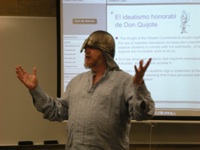
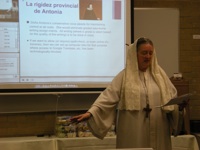
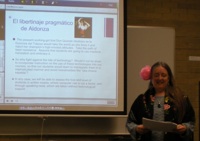
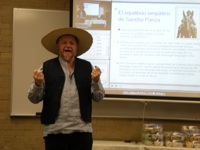
The morning concluded with a highly entertaining performance by LC's Rick Treece and CARLA's Marlene Johnshoy. They addressed the topic of online machine translators, such as Google Translate, and illustrated through donning costumes depicting figures from Cervantes' Don Quixote various viewpoints on how language programs might view students' temptations to take advantage of these increasingly accurate translation services.
While the virtuous Don Quixote trusted in students' honor to resist this temptation or to avail themselves of it judiciously, Donna Alvera would ban the use altogether, Aldonsa would encourage liberal use, and Sancho Panza would try to find a middle ground.
 Rick then shared some course policies on the use of machine translators in specific writing assignments and provided a few models for scaffolding assignments which would allow students to construct their production in stages, relying on authentic input and models rather than on translating from English to French, for examples.
Saturday afternoon include three informative sessions dealing with the use of Audacity in developing Spanish pronunciation, administrative restructuring of the Language Center at Gustavus Adolphus College to increase student worker participation and responsibility in the running of the center, and an informative presentation on a cross-cultural international project in which roughly 30 students and their instructor at a law school in Omsk in Siberia are connected to three instructors in the United States.
The project uses WebX as a synchronous video conferencing tool. Jan Marston talked about the division of responsibilities among the four instructors, with one person serving as the room manager, another as the facilitator conducting the lesson. A third is the coach, who monitors the synchronous text chat, and the fourth is a kind of prompter to help keep the conversation going. The presentation clearly illustrated the need for support staff to facilitate the various aspects of using technology in such a project.
The MWALLT conference was an opportunity for us to connect with colleagues from around the region and to share ideas and experiences. We returned to Minnesota with fresh ideas and renewed vigor. We look forward to participating in next year's conference which will with all likelihood be held at Gustavus Adolphus College in St. Peter, Minnesota. We invite you to consider attending.
The conference began on Friday afternoon with two presentations from Winona State University. Julie Gonzalez demonstrated Windows Photo Story 3 as an effective tool for producing image-based video, and Armando Gonzalez talked about various tools for students and instructors to use to produce audio and video and to store their work on the Web. He highlighted Windows Movie Maker and Audacity, pointing to Irfan View as convenient and inexpensive storage option.Highlights of the conference included the Friday afternoon presentation by Alyssa Ruesch and Marlene Johnshoy who presented their work in designing and conducting a fully online course for language teachers and administrators dealing with social media and its role in the foreign language curriculum. The course was offered by the Center for Advanced Research in Language Acquisition (CARLA), located at the University of Minnesota. This 9-week course offered during the summer of 2001 was extremely popular with 27 participants from around the world.
The course used a Ning as a management tool, and introduced participants to a variety of social media, including Twitter, Facebook, YouTube, and VoiceThread, and a newly discovered tool, called Wetoku, which allows two participants to carry on a video conversation remotely and records both sides of the conversation. Although the course involved a great deal of work and attention for the facilitators, there was a high degree of engagement and innovation on the part of the participants, and their assessment of the course was extremely positive. CARLA plans to offer the course again this coming summer, reduced from 9 weeks to 5.Saturday morning included two very interesting presentations, one virtual and the other theatrical. Jeff Kuhn joined us virtually from Ohio University to talk about revitalizing and repurposing Hot Potatoes, the exercise creation software produced at the University of Victoria. He showed us how to embed a variety of interactive web media within a standard HTML page created by Hot Potatoes to provide guidance and assistance for students to interact with this media. These HTML pages can be uploaded to a Moodle course site, and with a Hot Potatoes Moodle extension can even be connected to the Moodle course grade book. Examples included embedding Google Earth, an interactive timeline illustrating immigration patterns, and even a Moodle course site itself.
A lively discussion ensued.The morning concluded with a highly entertaining performance by LC's Rick Treece and CARLA's Marlene Johnshoy. They addressed the topic of online machine translators, such as Google Translate, and illustrated through donning costumes depicting figures from Cervantes' Don Quixote various viewpoints on how language programs might view students' temptations to take advantage of these increasingly accurate translation services.
While the virtuous Don Quixote trusted in students' honor to resist this temptation or to avail themselves of it judiciously, Donna Alvera would ban the use altogether, Aldonsa would encourage liberal use, and Sancho Panza would try to find a middle ground.
Rick then shared some course policies on the use of machine translators in specific writing assignments and provided a few models for scaffolding assignments which would allow students to construct their production in stages, relying on authentic input and models rather than on translating from English to French, for examples.
Saturday afternoon include three informative sessions dealing with the use of Audacity in developing Spanish pronunciation, administrative restructuring of the Language Center at Gustavus Adolphus College to increase student worker participation and responsibility in the running of the center, and an informative presentation on a cross-cultural international project in which roughly 30 students and their instructor at a law school in Omsk in Siberia are connected to three instructors in the United States.The project uses WebX as a synchronous video conferencing tool. Jan Marston talked about the division of responsibilities among the four instructors, with one person serving as the room manager, another as the facilitator conducting the lesson. A third is the coach, who monitors the synchronous text chat, and the fourth is a kind of prompter to help keep the conversation going. The presentation clearly illustrated the need for support staff to facilitate the various aspects of using technology in such a project.
The MWALLT conference was an opportunity for us to connect with colleagues from around the region and to share ideas and experiences. We returned to Minnesota with fresh ideas and renewed vigor. We look forward to participating in next year's conference which will with all likelihood be held at Gustavus Adolphus College in St. Peter, Minnesota. We invite you to consider attending.
Subscribe to:
Posts (Atom)