Go to the U of M home page
Showing posts with label Japanese. Show all posts

Monday, May 13, 2013

TandemPlus: Connecting Cultures and Communities through Communication

Anyone who's studied second language knows the difficulties. One is the discrepancy between book-learning and real-life language use; for example, the dialogues in second-language textbooks are scripted and complete, but real-life dialogues are full of false starts, interruptions, and other complications which are notoriously hard to negotiate on the fly. Also daunting are the cultural differences involved; ways of saying "How are you?" can vary one from one country to the next, even in those speaking the same language. Also, to attain true linguistic fluency, extensive and frequent conversation with native speakers of the language is required. Fortunately, a program exists at the University of Minnesota that allows participants to gain experience in all these areas, without leaving campus or even spending any money.

The TandemPlus cultural and conversation exchange program offers University of Minnesota students and community members the opportunity to use their second language skills with native speakers of the languages that they are learning. TandemPlus has different facets, including the Face-to-Face (F2F) Exchanges and the Class-to-Class (C2C) Exchanges.

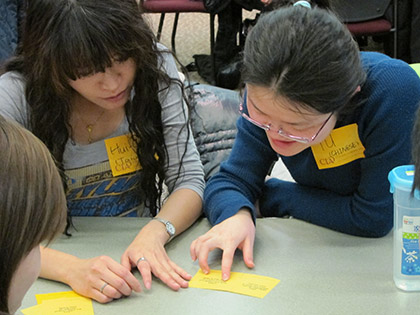
The most popular facet is the F2F program, in which individual students voluntarily enroll because they want to improve their second-language skills. After registering on-line and being matched by Tandem staff based on their personal and linguistic preferences, participants meet with one another in person on or around campus on a regular basis. These partnerships often grow into strong friendships. U of M student Sean Nelson, who participated in a Japanese-English F2F exchange during the Spring 2013 semester, stated,

Tandem has helped more than I would have ever imagined. I initially didn't know what I'd gain from a Tandem partner, but it has become such an amazing experience. I have become very comfortable with speaking Japanese, my listening comprehension has improved tremendously and my cultural understanding has improved greatly.

According to Nelson, his F2F partnership has also increased his vocabulary, helped him improve his performance in class, and more:

Along with all that, I've gained an amazing friend. I've gained experiences and information I don't feel I would have ever been taught in class. It has also helped prepare me for studying abroad this summer. And finally, it has connected me to the Japanese community at the University. Without my Tandem partner, I would have never thought about signing up to join the board of the Japanese Student Association, where I am now an officer and love every second of it.
Tandem

While the F2F program is individual and voluntary, the C2C program is done in conjunction with a language class at the University. In it, students are paired with a partner in a complementary language class abroad -- for example, students in a Spanish class at the U of M could be paired with students in an English class in Spain. Students communicate with each other in their first and second languages, using Skype or another on-line medium, and learn about different cultures while utilizing their language skills. Rick Treece is a French instructor at the U of M whose students have participated in C2C exchanges for several semesters. According to Treece, the program offers some great incentives for U of M students:
I liked the idea of giving my students authentic contact with native speakers their own age. The experience would be motivational from two standpoints: showing them how much they can really achieve in French already, and showing them what they need to work on in order to be more successful. The chances for cross-cultural insights (which is a big element of our French 1004 curriculum) was also attractive.
Treece pointed out that the opportunity did not come without challenges:
The mismatch of the academic calendars is a hassle. When we're putting together our Fall syllabus, the French are on vacation; they're not at work answering their emails, and even when they do reply, they don't know their enrollments or perhaps even their course assignments yet. The delay between the start of our Spring semesters is even worse, so that we end up with only about 5 weeks of course-time in common in the Spring, once you take out Spring Breaks, etc. The solution is just that we've learned to be flexible, to plan based on expectations, and then adjust in midstream.

Despite the challenges that came with the program, the benefits far outweighed the cost, according to Treece. He noted that while a "handful of students found it frustrating, even negative," the majority of his students had "pleasant and cordial" exchanges, and that some even had "life-changing experiences," such as the opportunity to visit their partner overseas.

All in all, TandemPlus is a free program that offers the potential for increased linguistic fluency, greater cultural awareness, or even a life-changing experience. The F2F program operates during all semesters of the academic year, including Summer, while the C2C program operates mainly during the academic year. Students or instructors who want to learn how to participate in these exchanges should get in touch with TandemPlus at tandem@umn.edu.
Tuesday, March 5, 2013

TandemPlus Bowling Night - A huge success!

Last Friday, March 1, TandemPlus hosted a Bowling Night in Goldy's Gameroom. The event lasted from 3:30-5:30 PM and drew a crowd of approximately 25-30 people, who spoke languages including Japanese, Chinese, Arabic, Russian, Malay, Farsi, Portuguese and English. It was such a hit that participants continued bowling and conversing long after the free bowling period ended! Many participants made new friendships and learned about many different cultures and ways of life. The next TandemPlus event will take place Friday, April 5. Stay tuned for more details.

Monday, March 4, 2013

TandemPlus: A record number of individual matches for Spring

Spring registration for TandemPlus is now closed, and we are thrilled to have such a large group of participants. This semester, 586 people registered, including many students from universities overseas, including Mexico, Russia, China, and France. Notable this semester is the large number of non-English Tandem pairings, including some Portuguese-French exchanges, Chinese-Korean exchanges, and Chinese-Japanese exchanges. Summer registration will open in May.

Tuesday, February 12, 2013

New Classroom Support Coordinator

Please welcome Caroline Vang, our new Assistant Classroom Support Coordinator. Caroline is an ESL-MA student whose area of research is in Japanese-American heritage language learners and how/why they code-switch during their conversation. She received her B.A. from the University of California-Berkeley and she currently teaches ESL at the University of Minnesota.

Thursday, October 25, 2012

The LPE Changes with the Times

The Language Testing Program now offers computerized Language Proficiency Exams (LPEs) in more languages than ever before. Tests currently in development feature culturally-rich authentic source material such as clips from modern Korean film, a look at the Somali-speaking community in the Twin Cities, and much more!

scene from Korean film
Example of culturally authentic material that could be used in LPE
Computerized LPEs were established in 2001. Hundreds of language students take them each semester to fulfill the College of Liberal Arts (CLA) language requirement and as a gateway to advanced language study. The mission of the Language Testing Program has remained constant: to accurately assess students' ability to listen, read, write and speak in the target language.
However, the program has changed and grown since 2001. The LPE is constantly being improved and the pace of modernization and innovation has picked up in the last few years. The Language Testing Program has focused on two new goals since 2010:  to serve as many language students as possible and to improve the students' exam experience by including contemporary and diverse media from the target language culture.

Before 2010, a computerized test was available only for students of French, German and Spanish and a few related languages. Students of Asian and other less commonly taught languages were limited to paper-based tests, or had no exam options at all.

Tests are now in place for Arabic, Chinese, Hmong, Italian, Japanese and Russian, and there is a second version of the Spanish LPE. In addition, development is underway for Finnish, Korean, Somali, and Swahili. All of these tests were made possible through an influx of funding from Title VI and other sources, along with a committed effort on the part of the Language Testing Program and the individual language programs to work together tirelessly and collaboratively. Once all of the newer exams are completed, the LPE will be available for almost all non-Classical languages offered in CLA and will reflect the diversity of languages available at the University of Minnesota.

As new tests are created, the Language Testing Program and the developers aim to bring new depth to the student experience and to conform more closely to current trends in second language pedagogy with increased emphasis on culturally-rich contexts. The new exams retain the original LPE goal of validating the work of students in their four semesters at the university by providing an opportunity to show what they can do with the target language in a communicative context.

However, they are not just tests - they are also learning opportunities for students, highlighting something new about the culture, history, or people of the target language through the use of authentic materials. Students may learn, for example, how traditional holiday celebrations have changed over time as societies become increasingly multicultural. There are also explorations of how gender roles have shifted and how these shifts impact language as well as cultural practice. One exam features an innovative, and perhaps surprising, environmental initiative. Another explores the lyrics of a popular song from a YouTube video.

The piloting process for new LPEs often includes a survey of student opinions about the test. Reactions to the new authentic content have been overwhelmingly positive. Test-takers have said that they were surprised and pleased to see that they had no difficulty reading texts that they might encounter on a daily basis in the target culture.

Here are some sample student reactions:

It made me realize the potential of a real-life usage for the language I've been studying.

I liked that the readings were all things I'd have to figure out in real life. It was a very pleasant experience to read articles from Japan.


The Korean LPE also offers a significant technological innovation: the incorporation of authentic video segments into the listening section. The test includes five diverse clips from modern Korean film showing natural and interesting interactions between native speakers. The use of authentic video is an excellent platform from which to assess listening proficiency, since it ties closely to the construct of listening in a communicative context, where meaning is negotiated based on a variety of input sources. The Korean listening exam has already been piloted once, and the response to the test was enthusiastically positive. Students reported that they especially enjoyed the video segments and felt confident that they could understand content overall, even though there may have been a few words unfamiliar to them.

The Somali listening section will include some authentic video segments as well. This exam stands out because it is set locally and explores the lives of immigrants integrating with the larger community as they share their language and culture - a reflection of the changing face of the Twin Cities.

Since 2010, new LPE creation has been led by Gabriela Sweet, who has worked tirelessly to organize a rotating team of developers, coordinate with multiple departments and stakeholders, and keep all projects on time and moving forward. The Korean, Somali, and Swahili development teams also include Language Center AV Developer Alaina Witt, Item Reviewers Xinyi Wu and Meghan McFadden, and LC Technical Coordinator Diane Rackowski.

The current language-specific developers are:

Finnish: Dan Karvonen, Jaana Viljakainen

Korean: Hangtae Cho, Yunseong Cheong

Somali: Said Ahmed, Abdulkarim Maalin

Swahili: Angaluki Muaka


Much of the funding for Korean development has been provided by a CLA InfoTech Tools for Discovery Grant. Title VI funding managed by the Institute for Global Studies has provided some travel and development grants for Somali and Swahili.

The Language Testing Program and the Department of Asian Languages and Literatures plan to present the new Korean listening section featuring authentic video later this winter. The U of M language community will have an opportunity to see how the classic LPE format can be modernized with technology to provide students with an educational, culturally-rich, and even enjoyable testing experience.


Tuesday, August 7, 2012

TandemPlus and ESL at the St. Paul Saints Game

On Friday, July 27, TandemPlus co-hosted a night of baseball and fun with the Minnesota English Language Program. This is the first event co-hosted by these university programs and it was a great success! Both American and international students attended the Saint Paul Saints baseball game at Midway Stadium in St. Paul and spoke a variety of languages including Arabic, German, Japanese, Chinese, English and Spanish. Overall students had a great time and after 11 innings the Saints pulled through and won the game. The night ended with a spectacular fireworks show and celebration over the Saints win. We hope you will join us for our next event, and don't forget to mark your calendars -- Fall registration is less than a month away!

Thursday, December 15, 2011

TandemPlus News

On Friday, December 2, TandemPlus hosted the second annual "Mocktail Happy Hour" at the Tea House Restaurant close to campus. Seventeen students attended the event and spoke languages like Japanese, Arabic, Chinese, and English. We discussed everything from linguistic similarities to culture to politics, all while enjoying a delicious variety of Chinese appetizers. This was the last TandemPlus event for the Fall semester. The Tandem team hopes that you will all join them again next semester.